What if the “perfect” number of reps you’ve been chasing for years simply doesn’t exist? You’ve likely felt the exhaustion of high-intensity programs or the boredom of the standard 3×10 routine, yet the visible muscle definition you seek remains just out of reach. It’s common to feel stuck between the fear of “bulking” with heavy loads and the plateau of lifting too light. Finding the best rep range for muscle growth female lifters need is less about a single magic number and more about understanding how your body constructs tissue through intentional tension.
You aren’t a machine to be driven to failure; you’re a complex system to be nurtured through precise, biological programming. We’ll use the landmark March 2026 ACSM guidelines, which analyzed data from 30,000 participants, to architect a workout structure that prioritizes your long-term hormonal health. You’ll learn why total weekly volume is the primary driver of your transformation and how to apply the recommended 10 or more sets per muscle group for optimal results. This guide provides a clear, science-backed path to help you transition from accidental exercise to a framework of purposeful, sustainable strength.
For decades, the fitness industry has confined women to a narrow, often ineffective corner of the weight room. We were told that heavy weights were exclusively for men and that high-rep, low-weight sessions were the only path to a “toned” physique. This binary choice is a myth that ignores the complexity of human physiology. The reality is that the hypertrophy window, the physiological range where muscle tissue is stimulated to grow, is remarkably broad, spanning from 3 to 30 reps. Finding the best rep range for muscle growth female lifters can rely on means moving away from rigid templates and toward an understanding of biological construction.
Muscle growth is the essential foundation of the physical definition many women desire. It isn’t a process of destruction or punishment, but one of architectural development. Instead of the frantic, high-pressure energy of traditional fat-burning workouts, we focus on intentional strength. Rep ranges are not magic numbers; they are strategic tools used within a broader framework of progressive overload for women. By viewing your body as a complex system to be nurtured, you can choose the rep count that best suits your current energy and long-term goals.
The word “toning” has been used to sell endless repetitions with light weights. In truth, what we call tone is simply the visibility of well-constructed muscle. You can achieve this through various loads. Lifting in lower rep ranges (3-6) builds dense muscle by improving neurological efficiency, essentially teaching your brain to use the muscle you already have more effectively. This builds strength without the bulk many fear. Conversely, lifting in high ranges (15-30) can also stimulate growth, provided you reach a point of sufficient effort. Both ends of the spectrum serve a purpose in a balanced plan for the best rep range for muscle growth female athletes.
The 8-12 rep range has become the industry standard because it’s a highly efficient middle ground. It balances The Science of Mechanical Tension with the metabolic stress that signals the body to adapt. It’s a logistical sweet spot that allows you to accumulate volume without spending hours in the gym. However, the 2026 ACSM guidelines, based on an analysis of 137 systematic reviews, confirm that this range is a suggestion, not a biological law. It’s an excellent starting point for your journey, but your body is capable of responding to a much wider variety of challenges. You don’t have to be perfect; you just have to be consistent.
Your body isn’t a calculator; it’s a living system. While the total number of repetitions provides a structural outline for your workout, the mechanical tension experienced by your muscle fibers is what dictates the actual biological response. Mechanical tension is the physical force applied to your muscles during resistance. It is the primary signal that tells your body to invest resources into tissue construction. When you focus solely on hitting a specific count, you often sacrifice the quality of this tension. The best rep range for muscle growth female lifters can utilize is the one that allows them to maintain technical precision while challenging the muscle’s capacity.
This brings us to the “Effective Reps” theory. Research suggests that not all repetitions are created equal. The initial reps of a set serve as a rhythmic lead-in, but the final two or three reps, where the movement naturally slows despite your best effort, are the most transformative. These are the moments where the most high-threshold motor units are recruited. To see results, you don’t need to reach total physical collapse. You simply need to work within a consistent proximity to failure. This approach honors your body’s wisdom. It replaces the frantic “no pain, no gain” mentality with a disciplined, intentional practice of listening to internal cues.
The Rate of Perceived Exertion (RPE) is a 1-10 scale that allows you to gauge intensity without the pressure of a one-rep max test. For most women, staying within an RPE of 7 to 9 is the growth zone. This means finishing a set feeling like you could have performed one or two more reps with perfect form. Using RPE is a vital component of measuring fitness progress that respects your biological rhythm. It ensures you are applying enough effort to stimulate the best rep range for muscle growth female physiology requires while avoiding the depletion that leads to burnout.
While tension is the architect, metabolic stress and muscle damage are the supporting crew. That “pump” sensation is more than just a temporary visual change; it’s a signal for cellular swelling that aids growth. Women often recover from this metabolic stress faster than men. This is due to estrogen’s protective effects on muscle membranes and its role in repair. When you are Designing Your Strength Architecture, you can leverage this by using slightly shorter rest periods or higher rep finishers to nurture the muscle. If you’re ready to build this foundation with expert guidance, beginning with a program like EVORA Start can help you bridge the gap between theory and practice.
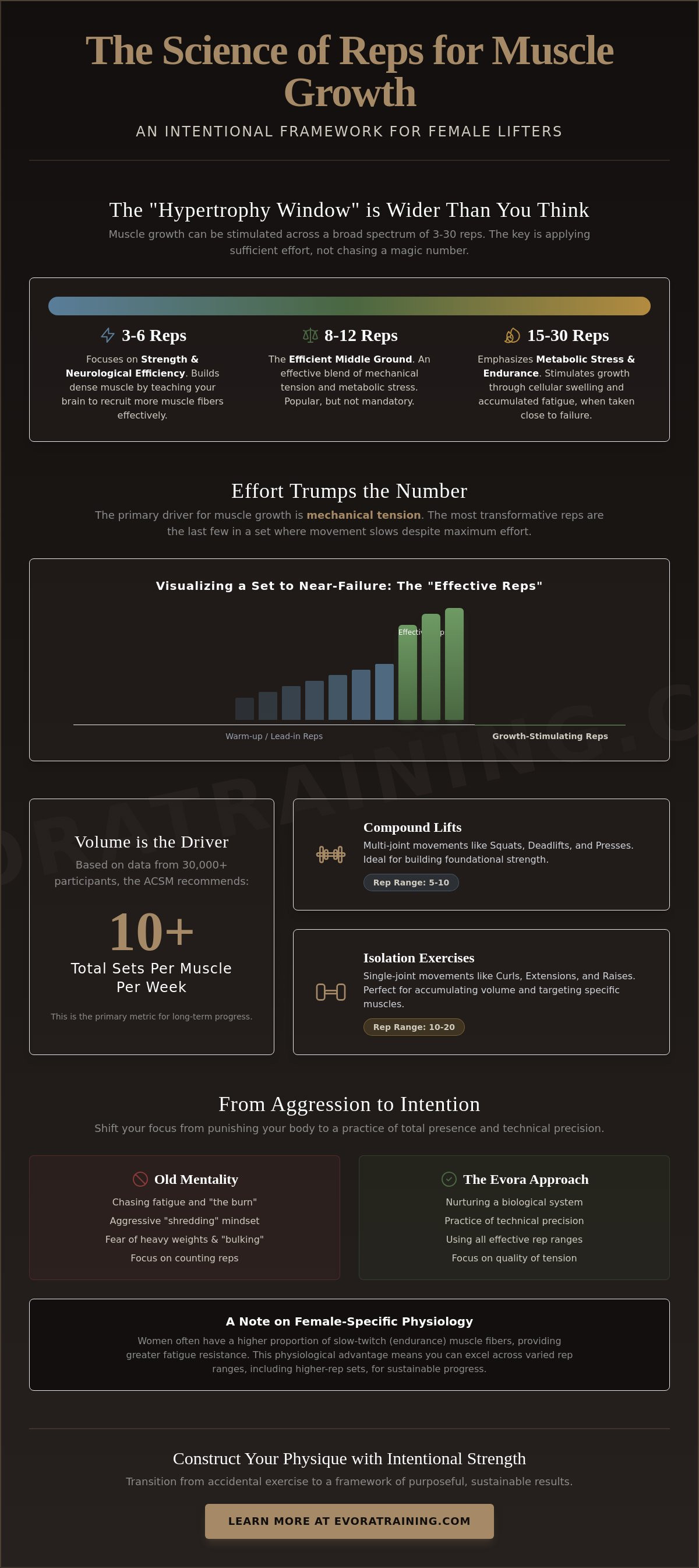
Mainstream fitness often treats the female body as a smaller version of the male one. This is a fundamental error. Your physiology has unique markers that dictate the best rep range for muscle growth female lifters should target for long-term health. One significant factor is fiber type distribution. Women generally possess a higher percentage of Type I, or slow-twitch, muscle fibers. These fibers are built for endurance and oxidative capacity. Because of this, you may find that your body thrives on slightly higher rep ranges or shorter rest intervals than traditional male-centric programs suggest.
A 2023 meta-analysis on resistance training for women highlights how these physiological nuances impact strength and hypertrophy outcomes. It reinforces the idea that training is a partnership with your biology, not a battle against it. Estrogen isn’t just a reproductive hormone; it acts as a protective, almost nurturing force for your muscles. It aids in tissue repair and provides a distinct advantage in endurance-based strength tasks. Instead of fighting your nature, you can architect your training to leverage these inherent strengths for better muscle construction.
Your cycle provides a rhythmic blueprint for your training intensity. During the Follicular Phase, rising estrogen levels often mean your body is primed for heavier loads and lower rep ranges, such as the 5-8 range. Once you enter the Luteal Phase, progesterone increases your core temperature and metabolic rate. This is the time to shift toward moderate reps (10-15) and prioritize intentional recovery. For a deeper exploration of this internal rhythm, see our guide on strength training for hormonal balance. This approach ensures you’re working with your body’s fluctuating energy rather than forcing a generic template.
Not all muscle groups are built with the same blueprint. Your lower body often features a denser concentration of Type I fibers, meaning your legs might respond more favorably to higher rep counts than your upper body. Cycling your rep ranges throughout the month ensures you engage both Type I and Type II fibers effectively. This variety prevents the stagnation common in generic plans. It keeps the process of muscle construction dynamic and responsive. By varying your reps, you ensure that every fiber type is nurtured and challenged, leading to a more functional and resilient physical framework. Finding the best rep range for muscle growth female success requires this level of biological intelligence.
Understanding the biological theory of muscle construction is the first step, but applying it requires a structured framework. Rather than following a generic template, you can use the “Architecture of Strength” to categorize your exercises. This method assigns specific rep ranges based on the physiological demands of each movement. It’s a calm, rational alternative to the high-pressure “go hard or go home” messaging that often leads to exhaustion. By choosing the best rep range for muscle growth female lifters need for specific lifts, you ensure that your energy is invested where it yields the highest return.
Foundational movements like squats, deadlifts, and overhead presses are the pillars of your physical framework. These multi-joint exercises require significant neurological focus and recruit multiple muscle groups simultaneously. Working in the 5–10 rep range allows you to use heavier loads that provide the mechanical tension necessary for structural density. Because these lifts are demanding, they require longer rest periods to allow your nervous system to recover. Understanding how compound lifts for women serve as the biological blueprint for hormonal health and skeletal longevity can help you approach these movements with greater confidence and intention. For those just starting, our guide on beginner strength training for women offers a clear path to mastering these essential patterns with technical precision.
Once the foundation is set, accessory movements like lateral raises, bicep curls, or glute kickbacks help refine the physique. These single-joint exercises are better suited for higher rep ranges, typically 10 to 15 or more. Lifting lighter weights for more repetitions creates metabolic stress, which is a key driver of the “toned” look many women desire. This approach also protects smaller, more vulnerable joints from excessive strain. It’s about nurturing the muscle through volume rather than forcing it through sheer weight. If you’re looking for a structured way to integrate these accessories into your routine, the EVORA Essentials framework provides the balance you need.
Consistency is more valuable than variety for its own sake. The “muscle confusion” trope often prevents actual progress by not allowing the body time to adapt. A more effective strategy is the Rule of 4-6 Weeks. Stick to a specific rep range and set of exercises for at least a month to allow for measurable progress. You’ll know it’s time to shift your architecture when you experience stalling progress, persistent joint aches, or a lack of mental presence during your sets. If stalling progress becomes a recurring pattern, understanding how to break a fitness plateau through intentional biological recalibration can help you move forward without resorting to brute-force intensity. Transitioning from a strength-focused block of 5–8 reps to a hypertrophy-focused block of 10–12 reps can keep your training fresh while respecting your long-term recovery. This intentional variety ensures that the best rep range for muscle growth female athletes use is always aligned with their current physiological state.
The science of resistance training provides the scaffolding, but your presence within each repetition determines the quality of the build. We’ve explored the broad hypertrophy window and the nuances of hormonal rhythms. Yet, the best rep range for muscle growth female success eventually transcends simple arithmetic. It becomes the range where you can maintain perfect technical precision and total mental focus. Numbers are merely a tool for intentionality. They should never be used as a metric for self-punishment or a reason to ignore your body’s signals.
We reject the common industry tropes that demand you “crush” your goals or “shred” your physique. These aggressive verbs imply that your body is an enemy to be conquered rather than a complex system to be nurtured. True transformation is a quiet, steady process of construction. It is about building a physical framework that supports your daily life, from carrying groceries with ease to maintaining bone density as you age. This shift from physical punishment to measurable progress is the hallmark of a mature, grounded approach to well-being.
When your physical framework is strong, you are better equipped for major life transitions; for instance, if you are planning a relocation, you can explore Residential Moving to find professional support that respects the effort you put into your own body’s construction.
Our modules are designed to remove the friction of decision-making. In both EVORA Start and EVORA Essentials, we pre-calculate these rep ranges based on your current physiological niche. This allows you to focus on the work of movement rather than the math of programming. We prioritize intentional movement over high-intensity depletion. Our female body transformation program is built on the belief that longevity is the ultimate goal. We don’t offer temporary fixes or generic templates; we provide a logical, science-backed path that respects your long-term hormonal health.
Transformation is often born from a state of frustration. You may have felt underserved by traditional methods or exhausted by programs that didn’t account for your unique biology. My own journey taught me that when we stop fighting our bodies and start partnering with them, the results become inevitable. You have the intelligence and the capacity to architect a life of strength. It’s time to move from confusion to empowered action. We invite you to explore the EVORA Start or EVORA Essentials modules to begin your intentional journey. This is your opportunity to build a foundation that is as resilient as it is functional. The best rep range for muscle growth female athletes can find is the one that allows them to show up, day after day, with quiet confidence and technical mastery.
You now possess the blueprint to move beyond the cycle of exhaustion and generic templates. True transformation occurs when you stop fighting your biology and start nurturing it through precise, intentional programming. By understanding that the best rep range for muscle growth female lifters need is a flexible tool rather than a rigid law, you can finally build a framework that feels as resilient as it looks. You’ve learned how to prioritize quality tension and respect your hormonal rhythms to ensure progress that lasts for years, not just weeks.
This methodology is founded on a real 110-pound transformation journey and is designed to help you avoid the common pitfalls of burnout. If you’re ready to stop guessing and start building with a system tailored to your unique physiology, it’s time to take the next step. Architect your strength with the EVORA Digital Training Programs to access science-backed modules that support your long-term health. Your body is a complex system to be understood. When you lift with intention, your physical capability becomes a powerful tool for your daily life. You’re capable of incredible growth; let’s build it together.
Toning is a result of muscle construction and body recomposition, not a specific rep count. While 12-15 reps create metabolic stress, the 5-8 range builds the structural density required for a defined look. Both are valuable tools in your strength architecture. Finding the best rep range for muscle growth female lifters need depends on balancing these different physiological signals rather than sticking to one “toning” zone.
You can absolutely build muscle using bodyweight exercises and higher repetitions. The key is reaching a high level of effort where the last few reps feel challenging. Research confirms that muscle growth occurs in ranges up to 30 reps if intensity is sufficient. This approach is excellent for maintaining joint health while still providing the signal your body needs to construct new tissue through consistent effort.
The March 2026 ACSM guidelines suggest a weekly volume of at least 10 sets per muscle group. This total volume is a more significant factor for hypertrophy than any single rep count. You might distribute these sets across two or three sessions per week. This structured approach ensures you provide a consistent stimulus for growth without overwhelming your body’s ability to recover and maintain its hormonal balance.
Muscles don’t need to be “confused” to grow; they need to be challenged consistently. Changing your rep range every week often stalls progress because your body never has time to master a movement and apply progressive overload. It’s more effective to stick with a specific architecture for 4 to 6 weeks. This allows for measurable improvements in strength and technical precision before transitioning to a new stimulus.
Lifting heavy for low reps focuses on neurological efficiency and structural density rather than excessive volume. You won’t wake up “bulky” because women typically have lower levels of androgenic hormones compared to men. Instead, heavy lifting creates a strong, capable foundation. It teaches your nervous system to recruit more muscle fibers, which is essential for achieving the best rep range for muscle growth female success over the long term.
Rest intervals should be long enough to allow your heart rate to settle and your focus to return. For compound movements like squats, 2 to 3 minutes is often necessary for neurological recovery. Isolation movements with higher reps generally require 60 to 90 seconds. This rhythm ensures you can perform every set with total presence and perfect form, turning your workout into a practice of intentional construction rather than frantic depletion.
Your training should evolve with your hormonal landscape, especially during perimenopause. As estrogen levels fluctuate, prioritizing resistance training becomes even more critical for bone density and muscle maintenance. You might find that your recovery needs change, requiring more intentional rest or a shift in volume. Adapting your rep ranges to match your current energy levels helps you maintain a resilient framework through every stage of life.
You don’t need to reach total physical collapse to see results. Working within a “proximity to failure,” specifically an RPE of 7 to 9, provides a sufficient signal for muscle construction. This means finishing a set feeling as though you could have performed one or two more reps with technical mastery. This empathetic approach protects your long-term health and prevents the burnout associated with high-pressure fitness messaging.