

What if the reason your progress has stalled isn’t because you’re doing too little, but because you’ve stopped listening to the architecture of your own biology? It is frustrating to wake up every morning, put in the work, and see the same numbers on the scale or the lifting rack. You might feel that you’ve reached a genetic limit, or perhaps you’re simply exhausted from trying to brute force your way through the stagnation. Learning how to break a fitness plateau in 2026 is not about finding a more aggressive workout; it’s about shifting from intensity to intentionality.
You deserve a training plan that feels like a partnership, not a punishment. This guide will show you how to decode your body’s signals and restructure your routine for long-term health. We will examine how your hormones impact your results and provide a clear, logical roadmap to restart your progress. By moving away from the status quo of depletion and toward a foundation of biological intelligence, you can finally move into a season of sustainable strength.
A fitness plateau is not a wall. It is a sophisticated state of physiological equilibrium. When your progress stops, it means your body has successfully mastered the current demands you have placed upon it. It has become efficient. It has reached a point where its current architecture is perfectly balanced with its environment. While this stagnation feels like a failure, it is actually a milestone of successful adaptation. Your body is simply waiting for a new, more intentional blueprint.
Many women fall into the “intensity trap” when they stop seeing results. The mainstream industry suggests that the only solution is to do more, go harder, or add more sessions. This approach often leads to depletion rather than development. Generic workout templates eventually succumb to the Law of Diminishing Returns. In this state, the same input no longer yields the same physiological output. Learning how to break a fitness plateau requires a shift from brute force to biological intelligence. It is about doing better, not just doing more.
Identifying a true plateau requires objective data rather than emotional frustration. You should look for specific markers in your training logs over a consistent period. These indicators suggest your current programming has matured:
It is vital to distinguish between a true physiological plateau and temporary fatigue. A stall is often a short-term dip caused by external stressors, poor sleep, or a specific point in your hormonal cycle. A plateau is a deeper, structural state where your current training volume and intensity are no longer enough to trigger new growth. Many women mistakenly try to “test” their maximum strength every week to see if they’ve improved. This habit creates unnecessary stress on the central nervous system and actually contributes to the stall.
Understanding the principles of Progressive overload is the first step in moving forward. Strength is built in the quiet moments of recovery, not during the high-pressure moments of testing. When you understand how to break a fitness plateau, you begin to view your body as a complex system to be nurtured. You learn to listen to the subtle signals that indicate it is time to pivot your strategy and build a new foundation for the next level of your strength journey.
The most common response to a stall is a reflexive return to the “eat less, move more” dogma. This approach is frequently the primary reason women encounter stagnation. When you increase physical demand while simultaneously restricting energy, you create a state of physiological alarm. Understanding how to break a fitness plateau often requires looking away from the gym floor and toward your plate. Your body is not a calculator; it is an adaptive system that prioritizes survival over muscle growth.
This survival mechanism is often called the Cortisol Trap. Chronic stress, whether from excessive training or life pressures, signals the body to preserve energy. High cortisol levels can lead to water retention and a stubborn refusal to change composition. To move forward, you must often implement a maintenance phase. This is a deliberate period of eating at your current metabolic baseline to reset your internal signaling. Developing a sustainable rhythm is at the heart of intentional training systems that prioritize longevity over temporary fixes.
To determine if your foundation is crumbling, you must monitor your biofeedback markers daily. These signals are the language of your biological intelligence:
Dietary protein is a non-negotiable requirement for breaking strength plateaus in women. It provides the literal building blocks for tissue repair and hormonal health. Incorporating “refeed” days, where you intentionally increase carbohydrate intake, can signal safety to your nervous system and support thyroid function. Caloric sufficiency is the mandatory structural requirement for any meaningful physiological change. Without enough energy, your body will simply refuse to invest in the expensive process of building new muscle.
The industry often overlooks the physiological nuances of workout plateaus, focusing on effort rather than recovery. Passive rest is simply the absence of movement, but active recovery involves low-intensity activities that promote blood flow without adding stress. Sleep is the most potent tool in your kit. Even moderate sleep deprivation blunts muscle protein synthesis, making it nearly impossible to recover from heavy lifting. Deload weeks should be a scheduled part of your training architecture. These are not signs of weakness; they are periods of planned construction where your body finally has the resources to solidify the gains you’ve worked for.
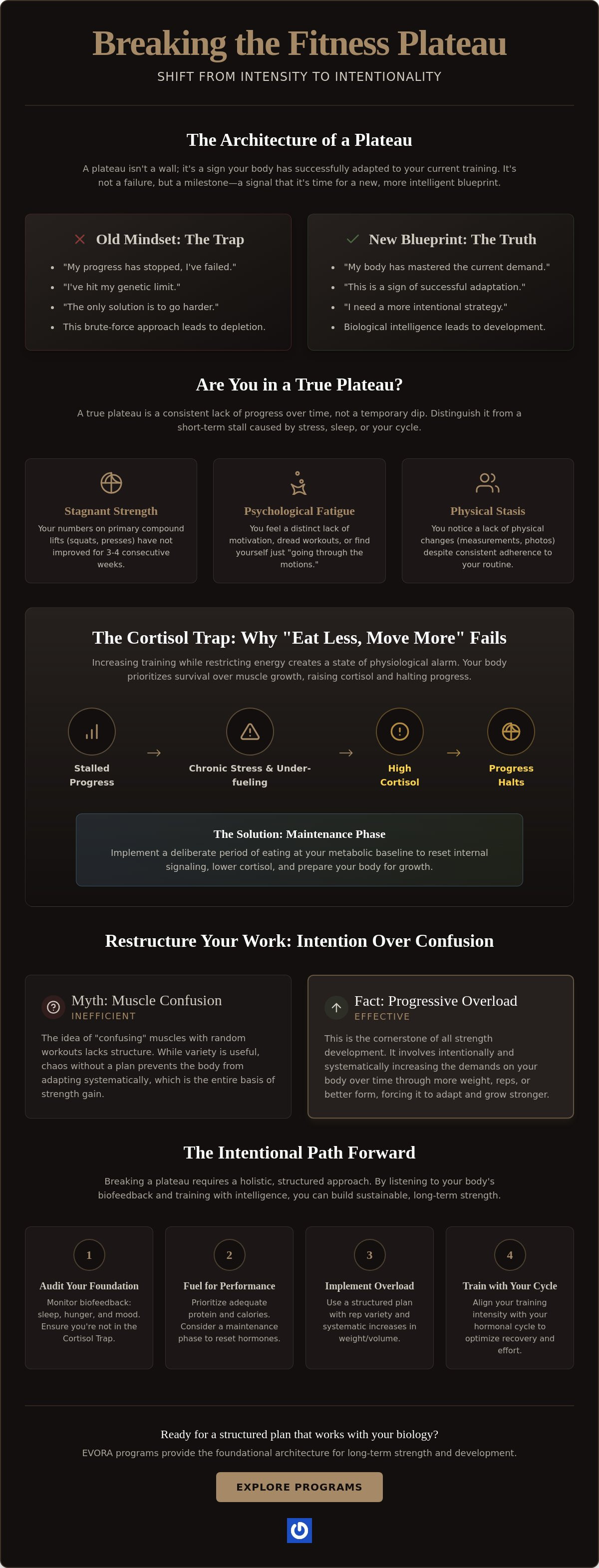
Muscle confusion is a myth that prioritizes novelty over mastery. Mainstream advice often suggests “shocking” the body with random variety, yet this approach only prevents you from becoming proficient in any single movement. If you want to learn how to break a fitness plateau, you must shift your focus from novelty to precision. Real growth happens when you refine the architecture of your current lifts rather than tearing the whole structure down every four weeks. Mastery requires consistency; progress requires specific, intentional adjustments.
The primary tool for this refinement is progressive overload for women. This isn’t just about adding more weight to the bar. It’s about increasing the total demand on your system in a controlled, measurable way. You can manipulate micro-variables like tempo, rest intervals, and range of motion to create a new stimulus. For example, slowing down the eccentric phase of a lift can restart progress without needing to increase the load. Compound lifts for women remain the cornerstone of this process because they provide the systemic hormonal stimulus necessary for structural change.
Sticking to a single rep range forever is a recipe for stagnation. By varying the best rep range for muscle growth female, you target different physiological adaptations. Undulating periodization allows you to move between high-rep endurance work and low-rep strength work within the same week. This keeps the body responding without losing the thread of mastery. Using Repetitions in Reserve (RIR) ensures that every set is intentional. It prevents the “brute force” exhaustion that leads to burnout while ensuring you’re working close enough to your limit to spark change.
The order of your sessions matters. If you’ve been stalling on your overhead press, moving it to the very start of your workout when your central nervous system is fresh can break the cycle. Accessory movements shouldn’t be random; they must support your primary lifts by strengthening the smaller muscles that might be the weak link in your chain. If a specific movement has truly peaked, try a “same-pattern” swap. Replacing a barbell back squat with a heel-elevated goblet squat maintains the movement pattern while providing a fresh stimulus to keep your progress moving forward.
Just as you would optimize your fitness routine with specific, high-value changes, creative professionals must also make informed decisions about their resources; for those in music, Supreme Tracks offers a comprehensive look at session musician rates to help artists budget effectively.
Mainstream fitness advice is often built on a foundation of male physiological data. It assumes a linear progression that ignores the rhythmic nature of the female body. If you want to learn how to break a fitness plateau, you must embrace Hormone-Smart Fitness. This approach moves away from the exhaustion of brute force and into the clarity of biological intelligence. Your strength and recovery capacity are not fixed. They fluctuate alongside your estrogen and progesterone levels. When you align your training with these shifts, you stop fighting your body and start building a partnership.
Most women experience a stall when they try to maintain high-intensity output during phases of the month that prioritize recovery. By reframing your training as a series of seasonal shifts, you can avoid the stagnation described in the architecture of a plateau. Estrogen is your primary ally for building tissue and increasing strength, while progesterone signals a time for systemic maintenance. Understanding this rhythm is the missing link in traditional plateau advice. It allows you to push when your body is primed for growth and pull back when it requires rest.
The first 14 days of your cycle represent a window of high physiological capability. As estrogen rises, your body becomes more resilient to the stress of heavy lifting. During this time, your insulin sensitivity is at its peak, allowing for more efficient fuel utilization during high-effort sets. This phase serves as the primary construction window for your physical architecture. It is the optimal time to chase Personal Bests and lean into progressive overload. You have a biological advantage during these weeks that makes structural change more accessible and recovery more efficient.
The luteal phase demands a different kind of intentionality. After ovulation, the rise in progesterone causes an increase in core temperature and resting heart rate. This shift significantly increases your perceived exertion, meaning the same weights will feel heavier and more taxing than they did a week ago. Pushing through this phase with high intensity often leads to the Cortisol Trap we discussed earlier. Instead, reframe this time as a season for building resilience through moderate volume and active recovery. Pulling back is not a setback; it is a strategic preservation of your progress. If you are ready to build a training routine that respects your biology, explore the intentional programming at EVORA.
Breaking a stall is not a matter of trying harder. It is a matter of building better. When you understand how to break a fitness plateau, you realize that your body requires a structured blueprint rather than a collection of random efforts. The EVORA tiered system is designed to provide this exact architectural framework. By moving through EVORA Start, EVORA Essentials, and eventually EVORA Elite, you ensure that every rep serves a specific purpose in your long-term development. This isn’t just about movement; it’s about precision-based programming that respects your biology.
EVORA Start focuses specifically on the foundational architecture of strength. It addresses the structural weak points that often lead to early stagnation. Instead of guessing which variables to change, you move into a state of knowing. This science-backed digital training removes the mental burden of programming, allowing you to focus on the execution of your lifts. You move away from the high-pressure industry messaging of “more is better” and toward a rational alternative. You aren’t just an athlete; you’re an intelligent individual who deserves a plan that acts as a partnership. This intentional approach ensures that your progress is built on a solid, lasting framework rather than a temporary fix that will inevitably fail.
There is a fundamental difference between exercising and training. Exercising is often a cycle of depletion focused on immediate exhaustion. Training is a deliberate process of construction focused on long-term transformation. EVORA Essentials provides the sophisticated periodization necessary for intermediate lifters who have moved past the initial gains of a beginner program. It manages the delicate balance between volume and recovery, ensuring that you don’t fall back into the Cortisol Trap. It offers the peace of mind that comes from following a plan specifically designed for the nuances of your physiology. You no longer have to wonder if you’re doing enough; the architecture is already in place to support your growth. This structure replaces the frantic energy of random sessions with a steady, deliberate rhythm.
Transitioning from a plateau into the EVORA Start framework is an act of reclamation. It is a decision to stop fighting your body and start nurturing its potential. You don’t have to navigate this transition alone. The partnership and community within the EVORA ecosystem provide the support needed to maintain momentum when things feel challenging. Moving past stagnation requires a change in strategy, not just a change in effort. You can choose to remain in the cycle of frustration, or you can choose a path grounded in biological intelligence and measurable progress.
Discover the EVORA Start program and begin building your foundation today.
A plateau is not an end point; it’s an invitation to upgrade your physical architecture. You have learned that stagnation is often a sign of successful adaptation, requiring a shift toward hormone-smart periodization and strategic recovery. Understanding how to break a fitness plateau means moving away from the “brute force” mentality and toward a partnership with your biology. By auditing your nutrition and respecting your cycle, you create a sustainable path forward that avoids the exhaustion of mainstream methods.
This methodology is founded on a personal 110-pound transformation journey and validated by clinical research. There’s no aggressive jargon here, only a commitment to intentional progress. You don’t have to guess about your next steps or settle for generic templates that ignore your unique physiology. Start your intentional strength journey with EVORA Start and move into a season of measurable, lasting strength. Your body is a complex system to be understood, and it’s ready for its next level of construction.
A fitness plateau lasts as long as your current physiological equilibrium remains unchallenged by a new stimulus or adequate recovery. Most professionals identify a plateau after four to six weeks of stagnant performance data in your primary lifts. Understanding how to break a fitness plateau requires an audit of your training variables rather than waiting for time to resolve the stagnation on its own.
Adjusting your nutritional intake can resolve a plateau if the root cause is energy deficiency or hormonal stress. If you’ve been in a chronic caloric deficit, your body may have entered a protective state that halts muscle construction. Implementing a maintenance phase or increasing protein intake signals safety to the nervous system. This allows the body to resume the structural adaptations and strength gains it previously paused.
Varying your rep ranges is generally superior to changing exercises because it allows you to maintain movement mastery while providing a fresh stimulus. This method, known as undulating periodization, is a core strategy for how to break a fitness plateau without losing the technical proficiency required for compound lifts for women. Randomly swapping exercises often leads to novelty without the deep structural change found in varied intensity and volume.
Overtraining is signaled by a systemic crash in biofeedback markers like sleep quality, mood, and resting heart rate. A plateau is characterized by stagnant performance in the gym without the pervasive exhaustion or loss of appetite associated with overreaching. If you feel physically capable but the numbers won’t move, you’re likely in a plateau. If you feel depleted and irritable, you’re likely overtrained and need recovery.
A strategic deload week is more effective than a complete cessation of activity for most women. Total rest can lead to a loss of movement rhythm and technical sharpness. A deload involves reducing volume and intensity by approximately 50 percent to allow the central nervous system to recover. This intentional reduction in stress provides the space for your body to solidify previous gains without losing your foundational momentum.
Age influences your hormonal landscape and recovery capacity, which can lead to more frequent plateaus if your programming isn’t adjusted. During life stages like perimenopause, shifts in estrogen can impact muscle protein synthesis and bone density. An intentional approach that prioritizes heavy lifting and longer recovery windows is necessary to navigate these biological changes. Age isn’t a limit; it’s a variable that requires more precise training architecture.
You can overcome stagnation with bodyweight movements by manipulating mechanical disadvantage and tempo variables. Increasing the difficulty of a movement, such as moving from a standard pushup to a deficit pushup, provides a new challenge for the muscular system. However, for long-term strength development, the body eventually requires the specific load that external weights provide to continue its growth and adaptation process effectively.
Sleep is the mandatory window for the repair and construction of muscle tissue. During deep sleep, the body releases growth hormones that are essential for recovering from the stress of progressive overload. If you consistently get fewer than seven hours of rest, your body can’t complete the necessary biological maintenance. Prioritizing sleep is often the simplest and most effective way to restore your capacity for physical progress.