

What if the most demanding phase of your training program isn’t the final set of heavy lifts, but the intentional decision to stop? For many, the concept of rest and recovery for female athletes is often misunderstood as a sign of weakness or a “day off” from progress. In reality, your body doesn’t build strength during the stress of a workout. It constructs it during the quiet intervals of restoration. If you’ve been battling chronic fatigue despite your dedication, you aren’t failing the grind. You’re likely experiencing metabolic compensation, a state where your system prioritizes survival over performance because the architectural foundation of rest is missing.
It’s natural to feel a sense of guilt when you aren’t moving, especially when mainstream fitness culture demands constant intensity. You deserve sustainable energy and faster repair, yet the line between active and passive recovery often feels blurred. This guide will show you how to transform rest into a strategic phase of physical construction and hormonal harmony. We’ll explore a clear recovery framework that respects your unique physiology and aligns with the latest clinical insights on energy deficiency. This approach moves you away from generic templates and toward a methodology that builds a resilient, lasting framework for your athletic life.
Training serves as the catalyst for change, but restoration is the architect of the result. Biological recovery is far more than the absence of movement. It’s the specific physiological window where your system repairs the micro-trauma incurred during exertion. Within the foundational principles of sports medicine, we recognize that physical adaptation is not an immediate byproduct of the workout. It’s a delayed response that only manifests when the body is granted the space to mend. Without this deliberate pause, you aren’t building a stronger version of yourself; you’re simply accumulating debt in a system that’s already overextended.
Mainstream fitness culture often treats the human body like a machine designed for endless depletion. We’re told that “crushing it” every day is the only path to success. This philosophy is a biological fallacy that leads to systemic exhaustion rather than growth. There’s a critical distinction between functional overreaching, which is a planned and temporary increase in training load, and overtraining, which represents a total failure of the body’s adaptive mechanisms. True progress requires a rejection of the “more is better” myth. By reframing your rest day as a “growth day,” you shift your focus from physical punishment to measurable progress. You’re no longer just stopping; you’re initiating a phase of foundational construction.
For the high-achieving woman, the greatest challenge isn’t the heavy lift; it’s the quiet afternoon. Effective rest and recovery for female athletes often requires more discipline than the most grueling training session. Many women face a persistent sense of guilt when they step away from the gym, fearing that a day of stillness equates to a loss of momentum. However, this psychological stress is not a neutral factor. It actively hinders physical repair by keeping the body in a state of high alert. A calm, rational approach to rest serves as a superior alternative to the cycle of shame. When you prioritize mental peace, you create the internal environment necessary for cellular repair. Choosing to rest isn’t an act of laziness. It’s a professional commitment to your long-term athletic longevity.
Ultimately, intentional restoration is a pillar of performance. It ensures that the work you put in at the gym actually translates into the results you seek. By treating rest and recovery for female athletes as a non-negotiable part of your programming, you move away from the frantic pace of the industry and toward a sustainable, research-backed path of physical development. For parents who want to support healthy physical development in their children, you can explore Tallori Growth Gummies to discover nutritional options for supporting growth.
To understand the necessity of rest and recovery for female athletes, one must view the body as a complex biological system rather than a simple machine. During the stress of training, you aren’t actually building muscle. You’re creating microscopic disruptions in tissue. The actual construction phase, known as muscle protein synthesis, occurs almost exclusively during downtime. This process is governed by the parasympathetic nervous system. When you transition into “rest and digest” mode, your body shifts its resources from external performance to internal maintenance. If the system remains in a state of high alert, the repair crew never gets the signal to begin work.
Estrogen is often misunderstood as merely a reproductive hormone. In the context of athletic development, it serves as a potent protective force for muscle tissue and bone density. It aids in the repair process and reduces the severity of exercise-induced damage. Research regarding monitoring female youth athletes highlights how these hormonal fluctuations influence both recovery needs and injury risk. During sleep, your body reaches its peak production of growth hormone. For women, this nocturnal window is the primary time for structural repair. If you cut this window short, you’re essentially halting the construction crew mid-shift. The female body is remarkably sensitive to the stress of under-recovery; it often interprets a lack of rest as a threat to systemic survival.
When you skip recovery, your body remains trapped in a state of high cortisol. This “stress state” is the enemy of progress. Chronic high cortisol levels don’t just make you tired; they actively blunt strength gains and prevent the metabolic efficiency required for fat loss. This hormonal imbalance can even impact thyroid health, slowing your metabolism to conserve energy. This is why many women find themselves training harder while seeing fewer results. If you’re feeling stuck, it’s worth reviewing the signs of overtraining in women to ensure your current volume isn’t exceeding your biological capacity. Intentional rest lowers systemic inflammation, which allows your muscles to function with greater precision and power.
Building a body that lasts requires more than just effort. It requires an architecture that respects your biology. If you’re ready to move beyond generic templates, exploring precision-based programming can help you align your training with your body’s natural rhythms. This logical approach ensures that every hour of rest is as productive as every hour in the gym.
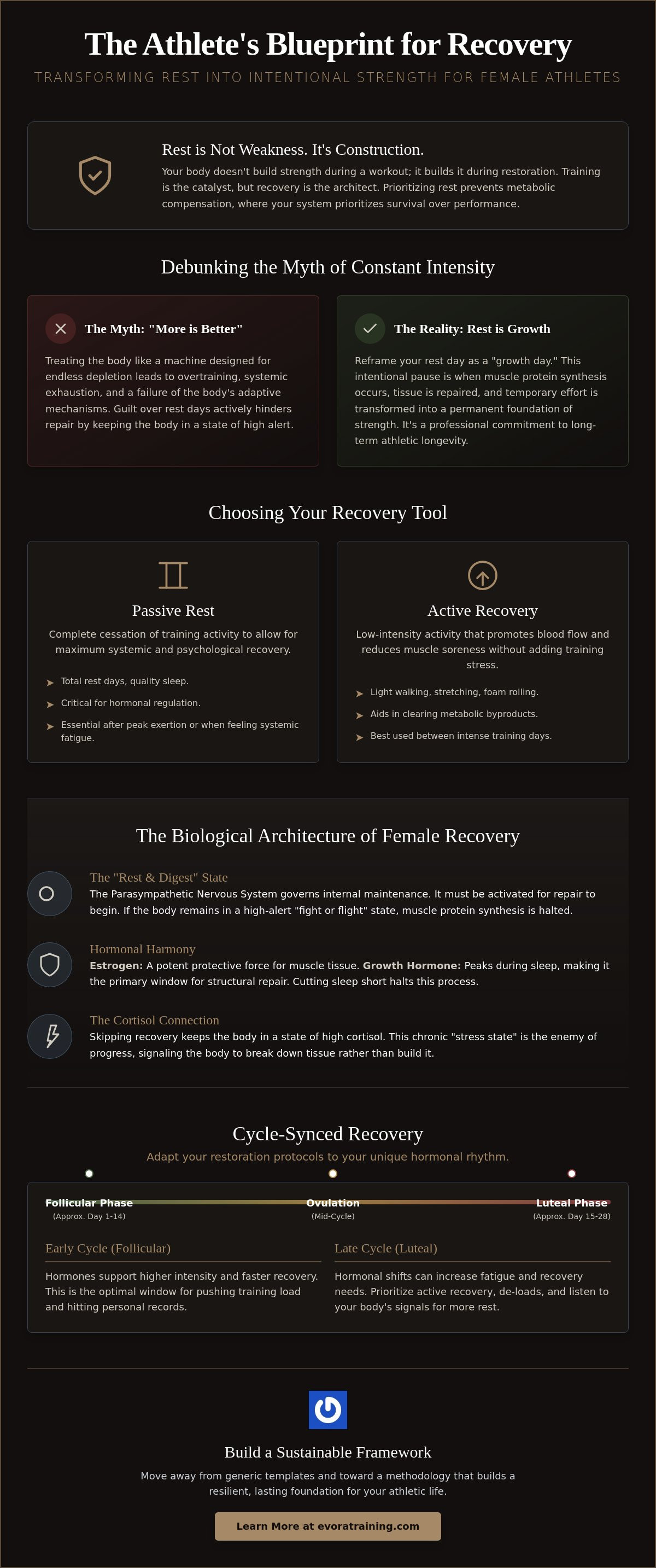
Precision is the hallmark of a sophisticated athlete. While the terms are often used interchangeably, rest and recovery for female athletes represent two distinct physiological strategies. Understanding when to apply each is the difference between true restoration and continued depletion. The importance of rest and recovery lies in recognizing which tool your body requires in its current state. Passive rest is a total cessation of training load. Active recovery is low-intensity movement designed to facilitate maintenance without adding to your systemic stress.
Choosing your tool requires an objective look at your biological data. Heart Rate Variability (HRV) serves as a reliable window into your nervous system’s readiness. When your HRV is significantly below your baseline or your perceived exertion for simple daily tasks feels unusually high, your body is signaling for a total stop. If you feel a mild physical “heaviness” but remain mentally sharp and your metrics are stable, low-intensity movement might be the superior choice. This logical framework replaces guesswork with biological intelligence.
Total biological stillness is necessary when the system is overextended by external factors. High life stress, illness, or the immediate aftermath of a peak competition demand a complete withdrawal from training. High-quality sleep is the ultimate form of passive rest; it’s the period when your brain and body perform their most critical structural maintenance. In these moments, doing nothing isn’t a failure of discipline. It’s a calculated decision that protects your long-term health and ensures your foundation remains solid for future challenges.
This phase focuses on gentle movement to encourage circulation rather than exertion. Activities like walking, gentle swimming, or restorative mobility work help move blood through the muscles, facilitating the removal of metabolic waste from the tissues. For many athletes, professional therapeutic sessions like those at Ines Massage are an invaluable addition to this routine, helping to release deep-seated tension that self-directed mobility work might miss. However, active recovery must never feel like a workout. If you find yourself checking the clock, pushing for a higher heart rate, or feeling a “burn,” you’ve crossed the line from nurturing to destroying. True active recovery leaves you feeling more energized than when you started.
Restoration is also a metabolic process. Your body cannot repair tissue or restore glycogen stores without the necessary building blocks. Aligning your intake with your activity level—specifically focusing on a hormone-smart post workout meal for women—provides the raw materials needed for strength gains. Understanding how intuitive eating and strength training work together can help you honor your body’s hunger signals on both training and recovery days, ensuring you never under-fuel the repair process. By pairing precision-based movement with strategic fueling, you turn every hour of downtime into a phase of active physical construction.
Mainstream fitness programming often operates under the assumption of a static biological environment. It expects the same level of output and the same rate of repair every single day. For the female body, this approach is fundamentally flawed. True rest and recovery for female athletes must account for the rhythmic fluctuations of your hormonal landscape. Your internal environment is a dynamic system, and your capacity for restoration shifts significantly as you move through your menstrual cycle. By aligning your downtime with your biology, you transform recovery from a guessing game into a precise tool for physiological harmony.
Understanding these shifts is the foundation of strength training for hormonal balance. When you respect the varying demands of your cycle, you stop fighting your own physiology. You begin to work with it. This intentionality ensures that you are providing the right level of support exactly when your system is most vulnerable to depletion.
The follicular phase, beginning on the first day of your period and lasting until ovulation, is a window of high biological resilience. During this time, estrogen is the dominant force. Estrogen is naturally anabolic and anti-inflammatory; it speeds up the repair of muscle tissue and improves your body’s ability to handle high-intensity stress. Recovery protocols during this phase can follow a standard rhythm. Your energy levels are typically higher, and your system is primed to capitalize on strength gains. You can often handle shorter recovery windows without risking systemic exhaustion, as your body is in its most efficient state for structural construction.
As you enter the luteal phase after ovulation, progesterone rises, and your biological priorities shift. Your core body temperature increases by about 0.5 degrees Celsius, which can significantly disrupt sleep quality and increase your resting heart rate. During this window, your body is under a higher metabolic load even at rest. This phase requires more aggressive and intentional rest strategies. Recovery slows, and the risk of accumulating systemic inflammation increases. You should adjust your active recovery to focus on nervous system regulation rather than movement for the sake of movement. Prioritize cooling strategies to support deep sleep and recognize that your body needs more downtime to achieve the same level of repair it managed easily two weeks prior.
Effective restoration is not about doing less; it is about doing what is necessary for your current biological state. If you are ready to build a program that respects your natural rhythm, you can explore our precision-based frameworks to start training with biological intelligence. This approach ensures your hard work leads to lasting progress rather than eventual burnout.
Sustainable progress is not the result of accidental downtime. It is the product of an architecture that views rest and recovery for female athletes as a primary training stimulus. In our methodology, we reject the notion that training must be exhaustive to be effective. Instead, we prioritize intentionality. When you shift your focus from physical punishment to measurable progress, you begin to see downtime as a strategic phase of structural construction. Exhaustive training treats the body as a resource to be spent. Intentional training treats it as a system to be developed.
Within EVORA Start and EVORA Essentials, rest days are not merely gaps in the schedule. They are built directly into the architecture of the program. We utilize de-load weeks as a non-negotiable component of long-term strength programming. These periods of reduced volume allow your central nervous system to reset and your tissues to complete the repair processes discussed earlier in this guide. By planning for these intervals, we ensure that your system never reaches a state of biological depletion. This structured approach provides the relief and clarity needed to move from a state of frustration to one of consistent, empowered action.
Physical capability is a tool for a vibrant life, not just a visual outcome. Our tiered programs, which scale from foundational work to EVORA Elite, respect the biological intelligence of the female body. We move away from the frantic, high-energy pacing common in mainstream fitness and toward a flow that feels grounded and focused. Intentional strength is the balance between precision training and deep restoration. This perspective treats the body as a complex system to be understood and nurtured rather than an enemy to be conquered through sheer intensity. By focusing on substance over aesthetics, we create a lasting framework for health.
Transitioning from a state of chronic exhaustion to one of empowered action begins with a “rest audit.” Take an objective look at your current training schedule and identify where the “more is better” myth might be causing harm. Are you prioritizing high-quality sleep as the ultimate passive rest? Are you adjusting your intensity based on your hormonal rhythm? If your current routine feels like a cycle of depletion, it’s time to adopt a more logical path forward. We invite you to explore the EVORA training modules for a structured, science-backed approach to your development. By integrating the principles of rest and recovery for female athletes into your daily life, you build a framework that supports your strength today and your health for years to come.
The path to lasting strength is paved with intentional stillness. By understanding that your body constructs muscle during downtime and respects the unique demands of your hormonal cycle, you move from a state of constant depletion toward one of biological intelligence. Effective rest and recovery for female athletes is not a sign of weakness; it is the most sophisticated tool in your training program. You’ve learned that restoration is an act of construction and that your luteal phase requires a different architecture than your follicular phase.
EVORA was founded by Shannon Moore after her own 110lb transformation, a journey built on the realization that long-term hormonal health must always take precedence over temporary intensity. Our science-backed training modules are specifically designed to respect female physiology, offering a logical alternative to the aggressive methods that lead to burnout. It’s time to view your body as a system to be nurtured rather than an enemy to be conquered. You don’t need to choose between progress and peace; you simply need a framework that accommodates both.
Begin your journey to intentional strength with EVORA Start and discover a methodology that builds you up without tearing you down. Your strength is a lifelong project; let’s build it on a foundation that lasts.
Most female athletes require at least two full rest days per week to maintain hormonal harmony and facilitate tissue repair. This number isn’t a fixed rule; it scales based on your training intensity and current life stress. High-achievers often benefit from a structured 3:1 or 2:1 ratio of training days to restoration days. This ensures the central nervous system has adequate time to exit a chronic stress state and prioritize recovery.
Passive rest involves a total cessation of physical exertion, such as sleeping or sitting, while active recovery uses low-intensity movement to promote circulation. Passive rest is essential when systemic fatigue or life stress is high. Active recovery, like a gentle walk, helps flush metabolic waste without adding new biological stress. Choosing the right tool depends on your current readiness and objective metrics like Heart Rate Variability.
Light cardio is acceptable only if it remains truly restorative and doesn’t elevate your heart rate into a training zone. If a “light jog” turns into a timed run, you’ve moved from recovery back into depletion. Activities like casual walking or leisurely swimming can support rest and recovery for female athletes by increasing blood flow to healing tissues without triggering a cortisol spike or further exhausting your system.
Recovery capacity fluctuates significantly across your cycle, with the luteal phase typically requiring more aggressive restoration strategies. During this high-progesterone window, your core temperature is elevated and your resting heart rate often rises. This makes the body more sensitive to stress and slows the repair of micro-trauma. In contrast, the follicular phase usually offers a window of higher resilience and faster, more efficient tissue reconstruction.
Persistent fatigue, disrupted sleep, and a sudden plateau in strength are primary indicators of systemic overreaching. You might also notice a lingering “heaviness” in your limbs or a loss of menstrual regularity. These symptoms signal that your training volume has exceeded your body’s ability to repair itself. Recognizing these signs early allows you to pivot toward intentional restoration before you reach a state of full biological burnout.
Sleep is the most potent recovery tool available and should always take precedence over a recovery workout. Most structural repair and growth hormone production occur during deep sleep stages. If you’re forced to choose between an extra hour of rest and a 20-minute mobility session, the sleep will provide superior biological value. A recovery workout performed on a sleep-deprived system only adds more stress to an already depleted framework.
Muscle construction happens exclusively during downtime, so taking consecutive rest days can actually accelerate your strength gains. This approach allows for a complete replenishment of glycogen stores and the full repair of muscle fibers. Strategic rest and recovery for female athletes prevents the chronic inflammation that often blunts protein synthesis. Two days of stillness provide the necessary window for your body to finally complete the building process.
You should maintain your protein intake on rest days to provide the constant supply of raw materials needed for tissue repair. Aiming for 1.6 to 2.2 grams of protein per kilogram of body weight ensures your system has the amino acids required for structural maintenance. Since muscle protein synthesis remains elevated for up to 48 hours after a session, your day off is actually a peak period for physical construction.