
What if the recurring fatigue you feel each month isn’t a sign of weakness, but a biological cue to shift your architectural focus? It’s exhausting to feel like your fitness progress follows a cycle of two steps forward and one step back. You likely know the guilt of missing a heavy lifting session when your energy levels plummet. We’ve been taught to view our bodies as machines that should perform identically every day. This approach ignores the reality of your hormonal rhythm and the specific needs of your system.
By embracing luteal phase strength training, you can stop fighting your biology and start working with it. You’ll learn how to transition from high-intensity pushing to intentional stability. This shift doesn’t mean stopping; it means refining. We’ll explore how to use this window to reinforce your foundation, reduce PMS symptoms, and create a sense of partnership with your own physiology. It’s time to replace the pressure of industry tropes with a structured, deliberate path toward sustainable strength and long-term well-being.
The luteal phase represents the 10 to 14 day window following ovulation. It’s a distinct biological chapter characterized by a dramatic shift in your internal chemistry. During this time, the body transitions from the high-energy, estrogen-dominant follicular phase into a state governed by progesterone. Understanding The Biological Blueprint of this transition is essential for anyone practicing luteal phase strength training. Instead of viewing this period as a time of physical decline, we should recognize it as a shift in our internal architecture. The structural tools that supported expansion last week are no longer appropriate for the foundational reinforcement required now.
Estrogen is often associated with a “superwoman” feeling; it’s anabolic and supports muscle building. When estrogen levels drop after ovulation, that explosive power often diminishes. Progesterone takes the lead. While progesterone has a calming effect on the nervous system, it’s also catabolic. It prioritizes the breakdown of amino acids rather than the construction of new muscle tissue. This hormonal environment also increases ligament laxity. You might feel less stable in your joints or notice a lack of “tension” during heavy lifts. Your metabolism also shifts. You may require more fuel, yet find that high-intensity bursts feel draining rather than invigorating.
Your body provides clear data when it enters this phase. You might notice a slightly elevated resting heart rate or a subtle increase in basal body temperature. This rise in core heat, often between 0.3 and 0.6 degrees Celsius, makes every movement feel more taxing. It’s common for your standard working weights to suddenly feel 20% heavier. This isn’t a loss of strength. It’s a natural recalibration of your system’s current capacity.
Common indicators of the luteal transition include:
Viewing these shifts as biological feedback allows you to adjust your approach without guilt. Luteal phase strength training isn’t about pushing through the fatigue. It’s about respecting the system’s need for maintenance and stability. By acknowledging these signs, you move from a state of frustration to one of empowered action, treating your body as a complex system to be understood rather than an enemy to be conquered.
In the high-progesterone environment of the luteal phase, the body’s internal priorities shift from outward performance to inward maintenance. Progesterone is inherently catabolic. This means it encourages the breakdown of tissues rather than their expansion. During this window, your system is less efficient at synthesizing new muscle and more prone to using existing protein stores for energy. Aligning your movement with these shifts is the essence of strength training for hormonal balance, a practice that replaces blind intensity with biological intelligence.
Thermoregulation also plays a critical role in your perceived exertion. As core temperature remains elevated, your body’s cooling mechanisms work overtime. You’ll likely notice that you sweat sooner and feel fatigued much faster during luteal phase strength training. This isn’t just a physical sensation; it’s a central nervous system (CNS) response. The CNS has a lower threshold for stress during this time. High-intensity loads that felt manageable days ago can suddenly feel like a systemic threat, triggering a protective fatigue response that limits your output.
Your body is working harder just to exist during the late luteal phase. Research indicates a slight increase in resting metabolic rate, as the system requires more energy to maintain the uterine lining and support elevated core temperatures. Catabolism, in the context of the menstrual cycle, refers to the physiological state where the body prioritizes the breakdown of tissues, such as muscle protein, to meet these rising energy demands. To buffer this, adequate carbohydrate intake becomes essential. Restricting fuel during this window often leads to significant cortisol spikes, which only further encourages muscle breakdown and systemic stress.
Recovery is not a lack of progress. It is a fundamental part of the construction process. During the luteal phase, systemic inflammation can increase, leading to more pronounced delayed onset muscle soreness (DOMS). Your body requires longer rest intervals between sets to allow the CNS to recalibrate. It also demands more high-quality sleep to manage the catabolic effects of progesterone. By extending your rest periods, you aren’t being “lazy.” You’re providing the necessary space for your physiology to maintain its foundation without reaching a state of depletion. This intentional approach ensures that your fitness journey remains a sustainable partnership rather than a cycle of exhaustion.
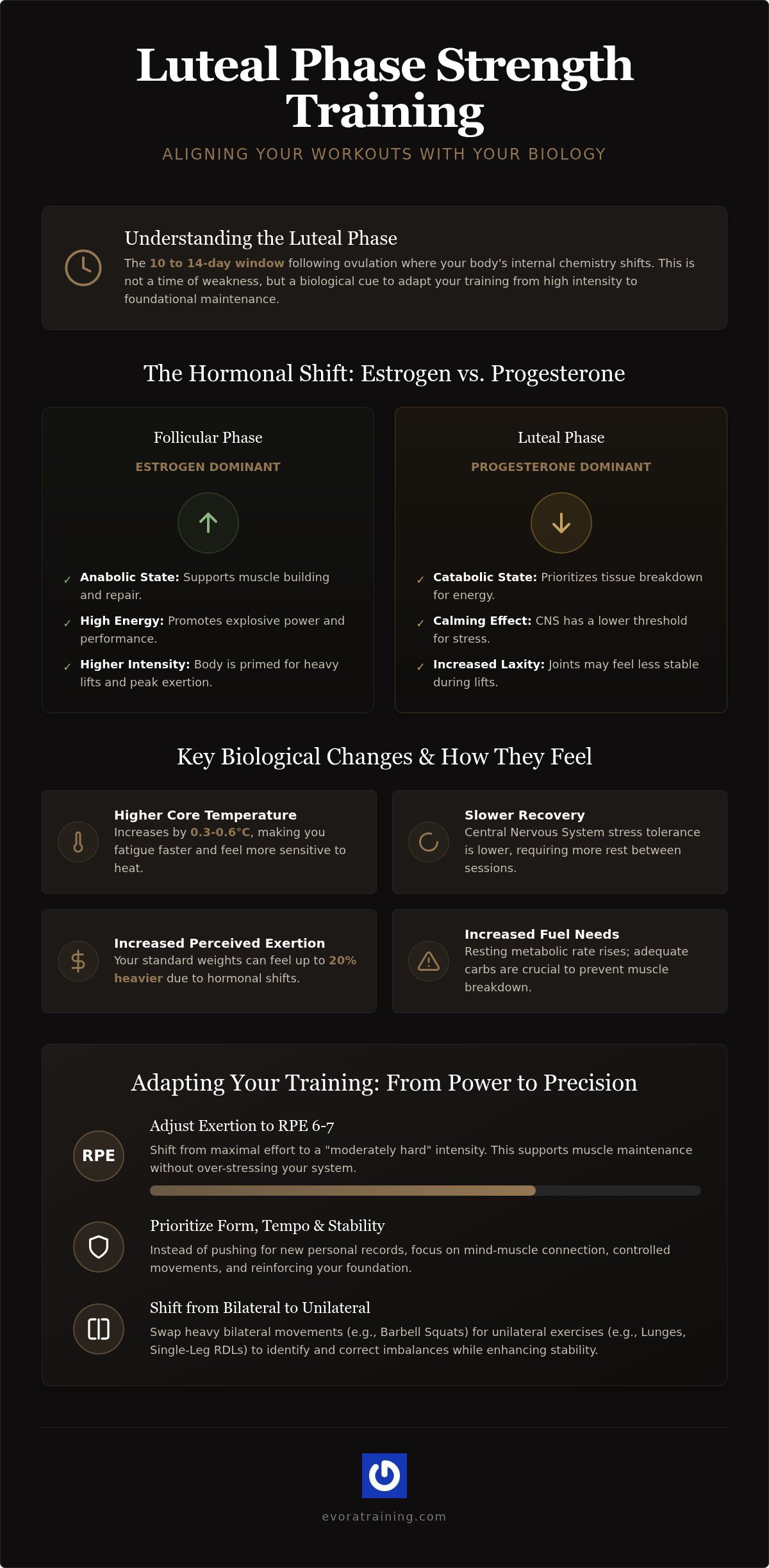
Mainstream fitness culture often presents a binary choice: either you “crush” your workout with maximum intensity or you skip it entirely. This “all or nothing” mentality is a disservice to your long-term progress. We propose a superior alternative called intentional stability. This approach moves the focus away from sheer output and toward the refinement of form, tempo, and mind-muscle connection. It’s a period for auditing your movement patterns to ensure your structural integrity remains intact. While beginner strength training for women focuses on building a base from the ground up, this phase of your cycle is about reinforcing the base you’ve already constructed.
The follicular phase is your window for expansion. It’s the time for chasing personal records, increasing volume, and testing your power. In contrast, luteal phase strength training shifts the goal to maintenance and technical precision. Maintenance is not a sign of stagnation. It’s a successful outcome that protects the gains you’ve already made. Think of your body as a high-rise building undergoing a scheduled structural inspection. The follicular phase is when you add new floors. The luteal phase is when you check the bolts, verify the alignment, and ensure the foundation can support the weight of future growth. Without this deliberate pause for reinforcement, the entire structure becomes vulnerable.
One of the most effective ways to maintain strength without exhausting your central nervous system is to manipulate tempo. By slowing down the eccentric phase of a lift, you create significant tension and stimulate muscle maintenance with lighter loads. This controlled descent allows you to feel every nuance of the movement. It’s also the ideal time to incorporate isometric holds. These pauses at the bottom of a squat or the midpoint of a row help improve joint stability during a window when progesterone may cause increased ligament laxity.
Focusing on quality over quantity nurtures your nervous system rather than depleting it. You’re still working. You’re still building. However, the nature of that work has changed from outward force to inward control. This shift ensures that you remain in partnership with your physiology, allowing for measurable progress that doesn’t come at the cost of your well-being. By the time your next cycle begins, you’ll have a more stable, more resilient framework ready for the next phase of expansion.
Mainstream fitness advice often suggests that yoga or light walking are the only viable options during the pre-menstrual window. While restorative movement has its place, this limited perspective ignores the physiological benefits of continued resistance training. Luteal phase strength training should focus on maintaining muscle tissue and supporting insulin sensitivity without pushing the system into a state of depletion. We prioritize compound movements but adjust the load to a Rate of Perceived Exertion (RPE) of 6 or 7. This approach emphasizes intentional strength over mainstream intensity, ensuring you remain active without triggering a stress response.
High progesterone levels can lead to a sense of internal heaviness or bloating. During this time, deep core engagement becomes a vital tool for managing intra-abdominal pressure and supporting pelvic health. Movements like Deadbugs, Bird-Dogs, and Pallof Presses are highly effective because they require precision rather than power. These exercises reinforce the connection between your breath and your deep stabilizers, providing a sense of structural security. Incorporating these mobility-focused strength movements can also help alleviate pre-menstrual tension by encouraging pelvic blood flow and reducing systemic rigidity.
Bilateral lifts, such as heavy back squats or deadlifts, place a significant demand on the central nervous system. In the luteal phase, unilateral work offers a superior alternative. Split squats and single-arm rows allow you to audit your form with a level of focus that is often lost during high-intensity sessions. These movements require less total load while still providing a robust stimulus for the target muscles. Unilateral work reveals compensatory patterns by highlighting which side of the body is over-relying on secondary muscles for stability. This auditing process is essential for long-term health, as it allows you to correct imbalances before they lead to injury.
By shifting your focus to these stability-based movements, you treat your body as a complex system to be nurtured rather than an enemy to be conquered. This intentionality ensures that your progress remains steady across every phase of your cycle. If you’re ready to transition from generic templates to a framework that respects your biological intelligence, explore our intentional strength programs designed for sustainable physical development.
Mainstream fitness often demands that you ignore your body’s signals in favor of a rigid, linear template. This approach leads to a cycle of depletion that is unsustainable for long-term health. EVORA Start offers a superior alternative. It’s designed as an intelligent entry point for those ready to embrace hormone-smart training. By aligning your movement with the specific needs of your biology, you move away from the frustration of “one step back” and toward a lasting framework of physical capability.
Each module within the EVORA system respects the natural ebb and flow of female physiology. We recognize that your capacity for output changes throughout the month. Instead of forcing intensity when your system requires rest, we provide the tools to navigate luteal phase strength training with precision. This methodology was developed by Shannon Moore, an empathetic expert who validated these principles through her own 110lb loss transformation. It’s a program rooted in both clinical research and personal experience, offering a structured path for those who’ve been underserved by traditional methods.
True progress isn’t found on a scale; it’s found in the integrity of your daily life. We encourage you to track markers that reflect systemic health, such as energy levels, sleep quality, and the regularity of your menstrual cycle. The EVORA method focuses on the architecture of strength for longevity rather than temporary aesthetic fixes. This approach requires you to listen to your body’s innate wisdom. When you prioritize foundational maintenance during the luteal phase, you aren’t stalling your progress. You’re ensuring the structure remains sound for years to come.
Building a sustainable foundation begins with a single, intentional choice. Our digital programs, including EVORA Start, Essentials, and Elite, provide a clear roadmap for every stage of your development. You can access these science-backed modules from anywhere, allowing you to integrate hormone-smart training into your existing lifestyle. This is more than a workout plan. It’s a partnership with yourself. Stop the cycle of depletion today. Choose to build a body that feels as strong as it looks by honoring the biological rhythm that makes you unique.
Your body is a complex system that requires a nuanced approach to development. By embracing luteal phase strength training, you reject the industry’s obsession with constant intensity. You’ve learned that the rise of progesterone is an invitation to shift from expansion to foundational reinforcement. This isn’t a period of stagnation. It’s a vital phase of structural maintenance. Success occurs when you prioritize form, stability, and recovery over sheer output.
Measuring progress through energy levels and cycle health ensures your fitness journey remains sustainable for decades. Our methods rely on science-backed programming for female physiology. They were refined through a 110-pound personal transformation to provide a path for long-term physical architecture. It’s time to stop fighting your biology and start building a lasting partnership with yourself. Begin your intentional strength journey with EVORA Start and discover a grounded way to move that respects your unique rhythm.
Lifting heavy is generally safe, but your capacity for maximum intensity often declines. During this window, progesterone increases ligament laxity, which can affect joint stability and increase the risk of minor strains. Instead of chasing personal records, shift your focus to an RPE of 6 or 7. This ensures you maintain your strength without overwhelming your central nervous system. It’s about protecting your structural integrity while respecting the biological shift occurring within your system.
Listen to your resting heart rate and perceived exertion levels as reliable data points. If your standard warm-up feels like a maximum effort, your body is signaling a need for recovery. Traditional fitness tropes tell you to push through the fatigue, but this often leads to systemic depletion. A successful rest day is an active part of the construction process. If you feel persistent lethargy or joint discomfort, choose restorative movement over high-intensity sets.
Intentional movement can alleviate several common pre-menstrual symptoms. Engaging in luteal phase strength training encourages blood flow to the pelvic region, which helps reduce bloating and physical tension. Controlled exercise also supports neurotransmitter balance, helping to stabilize mood swings. By choosing stability-focused movements like deadbugs or bird-dogs, you provide your body with a sense of security that counters the irritability and sensitivity often associated with this phase of your cycle.
Your metabolic rate increases slightly during the late luteal phase, requiring a modest increase in fuel. Prioritize complex carbohydrates to prevent cortisol spikes and support your fluctuating energy levels. Progesterone is catabolic, meaning it encourages the breakdown of muscle tissue for energy. Increasing your protein and carbohydrate intake provides the necessary building blocks to maintain your foundation. Avoid restrictive patterns that ignore these rising energy demands, as they can exacerbate fatigue and hormonal stress.
The luteal phase is considered catabolic because rising progesterone levels prioritize the breakdown of tissues to meet the body’s energy needs. This matters because your body is less efficient at building new muscle than it was during the follicular phase. Understanding this shift allows you to adjust your expectations. Instead of trying to force a plateau, focus on maintenance. This ensures you don’t lose the gains you’ve already constructed while your system is in a breakdown state.
Your core temperature rises by approximately 0.3 to 0.6 degrees Celsius after ovulation. This makes your body’s cooling mechanisms work harder, leading to earlier fatigue and a higher heart rate during exercise. You might feel breathless during sets that usually feel easy. Recognizing this thermal shift is a key part of luteal phase strength training. Adjust your rest periods and training environment to manage this heat, allowing your system to recover effectively between movements.
You won’t lose muscle by shifting to foundational maintenance for a portion of your cycle. In fact, lowering intensity protects your tissue from the catabolic effects of high progesterone. Constant high-intensity training during this window can lead to overtraining and muscle loss due to elevated cortisol. By refining your technique and using controlled tempos, you maintain your structural integrity. This deliberate pause for reinforcement prepares your body for more significant growth during the next follicular phase.
Use a combination of calendar tracking and basal body temperature monitoring for the most accurate results. Apps provide a general window, but tracking your morning temperature offers precise data on when ovulation has occurred. Notice when your energy begins to dip and when your heart rate increases during routine tasks. This biological data allows you to plan your transitions from power to stability. It turns your training into a predictable, science-backed framework rather than a guessing game.