What if the number on your bathroom scale is actually the least interesting thing about your body’s evolution? For too long, the fitness industry has used weight as a blunt instrument, ignoring the complex biological construction happening beneath the surface. You’ve likely felt the frustration of a stagnant scale despite feeling stronger and more capable in your daily life. Understanding how to measure fitness progress women can actually trust requires moving away from the noisy neighbor of gravity and toward a hormone-smart framework that respects your unique physiology.
We agree that your health is much more than a simple caloric deficit; it’s a steady rhythm of recovery and structural growth. You deserve a reliable system for tracking transformation that celebrates building strength over losing numbers. In this guide, you’ll discover a science-backed approach to monitoring your physical development. We will explore how to interpret your own biological data, align your training with your hormonal cycle, and finally understand the “why” behind your body’s changes so you can feel empowered rather than shamed by the data.
The scale is a blunt instrument. It measures your relationship with gravity, but it cannot see the complex biological construction happening within your frame. For many, the bathroom scale is a source of daily anxiety that dictates self-worth. This over-reliance on a single number is what we call the Scale Trap. It often leads to a cycle of restriction that triggers metabolic adaptation, where the body slows its energy expenditure to protect itself from perceived scarcity. When you focus solely on weight loss, you risk losing the very tissue that supports your longevity: muscle.
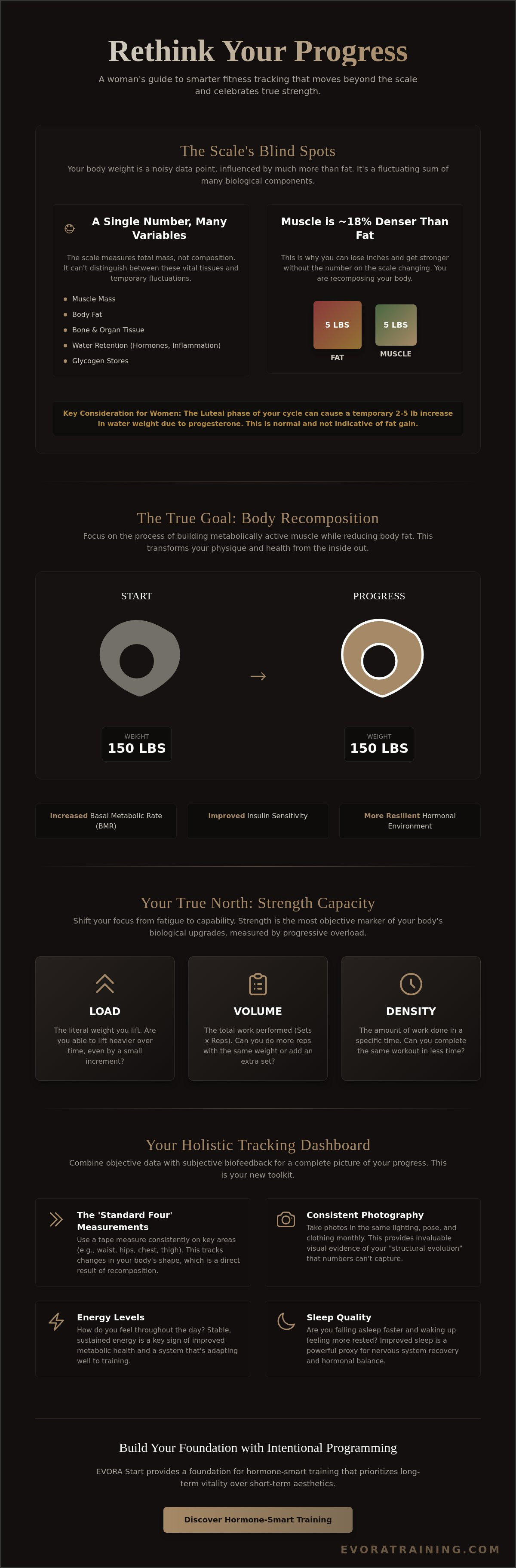
Learning how to measure fitness progress women can trust requires looking at the shifting mosaic of your internal environment. Your weight is not a static value. It is a fluctuating sum of bone, organ tissue, glycogen, and water. A single strength training session can cause temporary inflammation as your muscles begin the repair process, leading to water retention that looks like “weight gain” on a screen. Similarly, for every gram of glycogen your body stores for energy, it holds onto approximately three to four grams of water. These shifts are signs of a functioning system, not a failure of will.
Body recomposition is the superior alternative to traditional weight loss. It is the process of building lean muscle mass while simultaneously reducing body fat. Because muscle is roughly 15 to 20 percent denser than fat, it occupies significantly less physical space. You may find your silhouette sharpening and your clothes fitting with ease even if the scale hasn’t moved an inch. This is the hallmark of structural progress.
Building muscle is an investment in your metabolic future. Unlike fat tissue, which is relatively dormant, muscle is metabolically active. It requires energy just to exist. By focusing on muscle construction, you naturally increase your Basal Metabolic Rate (BMR). This shift improves insulin sensitivity and creates a more resilient hormonal environment. When people speak of “toning,” they are actually describing the visible result of well-developed muscle architecture. Understanding the various components of physical fitness helps you see that strength is the foundation upon which all other health markers are built.
A woman’s body operates on a rhythmic cycle that the scale simply cannot interpret. During the luteal phase of the menstrual cycle, progesterone levels rise, often leading to increased water retention and systemic inflammation. It’s common to see a fluctuation of two to five pounds that has nothing to do with body fat. Additionally, high levels of cortisol from life stress or overtraining can cause the body to hold onto fluid. We must reframe the scale as a singular, often noisy data point. It is one small piece of biological data, never a moral judgment on your dedication or your progress.
Mainstream fitness culture often prioritizes the sensation of fatigue. It asks you to “feel the burn” or “crush” your limits until you’re exhausted. This approach views the body as an enemy to be defeated rather than a complex system to be nurtured. A more rational path focuses on strength as the most objective marker of biological vitality. When you prioritize performance, you move away from the subjective feeling of tiredness and toward the objective reality of capability. Strength is the primary architect of physical longevity; it predicts your ability to remain active and independent for decades to come.
To understand how to measure fitness progress women can sustain, we must look at the three pillars of progressive overload: load, volume, and density. Load is the literal weight you lift. Volume is the total amount of work performed, often calculated as sets multiplied by repetitions. Density is the amount of work completed within a specific timeframe. If you can lift the same weight for more repetitions, or perform the same workout in less time, you have achieved a measurable biological upgrade. These metrics offer alternative ways to track fitness that are far more reliable than a daily weigh-in.
One of the most empowering data points is “Tonnage.” By multiplying the weight lifted by the total reps and sets, you see the literal weight of the progress you’ve constructed. If you moved 2,000 pounds last week and 2,100 pounds this week, your capacity has increased. This progress remains invisible to the scale but is undeniable in your training log. However, this data only remains valid if your form is consistent. True progress is never found in “cheating” a movement to move more weight; it’s found in the intentionality of every rep. Monitoring your rest intervals is also vital. Shortening a rest period from 90 seconds to 60 seconds while maintaining your performance is a clear sign of improved metabolic recovery.
Biological data isn’t always about the numbers on the plates. The Rate of Perceived Exertion (RPE) uses a 1 to 10 scale to measure how difficult a set felt. This tool is essential for auto-regulation, especially as your energy levels fluctuate throughout your hormonal cycle. On some days, a 100-pound lift might feel like an RPE 7; on others, it might feel like an RPE 9. Recognizing that a previously “heavy” weight has become a “moderate” one is a profound indicator of structural growth. This nuanced approach allows you to stay consistent without the burnout that comes from rigid, generic templates. If you’re ready to move toward a more intentional way of training, beginning with a framework like EVORA Start can help you align your efforts with your body’s natural rhythms.
The body isn’t a machine that produces linear results. It’s a complex biological system governed by a shifting hormonal landscape. When we consider how to measure fitness progress women can actually feel, we must look at physiological markers that the scale ignores. True progress often manifests first as improved energy, deeper sleep, and a more resilient nervous system. These internal shifts are the foundation of long-term structural change. If you wake up feeling refreshed and ready to move, your program is working. Sleep is the ultimate hidden metric; it’s the window in which your body repairs the micro-construction of your muscle tissue.
One of the most effective ways to monitor your progress is through the HEM framework: Hunger, Energy, and Mood. If your hunger is stable, your energy is consistent, and your mood is balanced, your training volume is likely in a “sweet spot” of recovery. Conversely, a “wired but tired” feeling often signals elevated cortisol from overtraining or insufficient recovery. Intentional strength training should nurture the nervous system, not deplete it. You’ll know your system is adapting when your resting heart rate remains steady and your recovery between sets feels effortless. This biological feedback tells you more about your metabolic health than any number on a digital display ever could.
A woman’s strength capacity is not a static value. During the follicular phase, when estrogen is rising, many women find they can reach a Personal Record (PR) with greater ease. Estrogen is naturally anabolic and supports muscle construction. In contrast, the luteal phase may require more grace as progesterone rises, slightly increasing your core temperature and metabolic demand. Progress isn’t just about the weight on the bar; it’s about how your body handles stress outside the gym. A well-designed program helps regulate your cycle and reduce the severity of symptoms like PMS or fatigue. This is why female body transformation programs must be hormone-smart to be effective. They prioritize the rhythm of your biology over a generic, high-pressure template.
We must also celebrate non-visual victories that indicate a higher quality of life. Improved posture is a direct result of a stronger posterior chain. Increased bone density, though invisible without a scan, is a vital shield against the frailty often associated with aging. Are you carrying groceries with less effort? Do you move through your day with a sense of functional ease? These are the truest markers of healthspan. When your body feels like a tool for daily life rather than a project to be fixed, you’ve achieved real progress.
Measuring progress shouldn’t be an act of obsession. It should be an act of observation. While the scale remains a blunt instrument, specific physical measurements provide a high-resolution map of your body’s structural changes. This data allows you to see the architecture of your progress even when gravity refuses to acknowledge it. By adopting a standard protocol, you remove the emotional weight from the process and replace it with objective clarity. Understanding how to measure fitness progress women can trust involves shifting your focus to the areas where muscle construction and fat reduction intersect most visibly.
The “jeans test” is often more accurate than any tape measure. Denim is unforgiving and does not fluctuate with your daily water retention in the same way your skin might. If a pair of trousers fits better in the waist but feels snug in the glutes or thighs, you’re witnessing the tangible results of body recomposition. This is the physical evidence of building lean mass. To document these changes with precision, we recommend maintaining a digital training log. Moving from pen and paper to sophisticated apps allows you to see long-term trends in your strength capacity and work volume, turning your effort into a visible history of growth.
The art of the progress photo requires consistency to be useful. Always use the same lighting, angles, and attire to ensure the only variable changing is your body. Side-profile photos are particularly valuable; they often reveal postural improvements and the “tightening” of the core that front-facing photos miss. Because of the hormonal shifts discussed earlier, you should only compare photos taken during the same phase of your menstrual cycle. Comparing a follicular phase photo to a luteal phase photo can be misleading due to natural water retention. Focus on the changes in your frame and muscle definition rather than just looking for “shrinkage.”
If you’re ready to move away from guesswork and begin a structured, science-backed journey, you can start your foundational training with EVORA Start today. This program is designed to help you implement these protocols while building lasting strength.
Mainstream fitness often feels like a war against the body. It relies on the destruction of fat as the only metric of victory. Evora Training offers a different path. It prioritizes the architecture of strength and the nurturing of your biological potential. When you understand how to measure fitness progress women can actually sustain, you stop guessing and start building with intention. This shift moves you away from the frantic energy of “trying everything” and toward a calm, rational system of physical development.
The transition to intentional programming requires a fundamental shift in mindset. You’re no longer chasing a lower number on a scale or punishing yourself for yesterday’s meals. Instead, you’re constructing a resilient physical framework. This Constructing a Lasting Framework for Your Vitality
The journey toward physical capability is a construction project, not a battle of attrition. By shifting your focus from the scale to the architecture of your own strength, you reclaim your relationship with your body. We’ve explored how body recomposition and progressive overload provide the objective data you need to thrive. Understanding how to measure fitness progress women can rely on means honoring your hormonal cycles and listening to the bio-feedback of your energy and sleep. These markers tell the true story of your evolution. You don’t have to navigate this transition alone or rely on generic templates that ignore your unique biology. Founded by 110lb transformation expert Shannon Moore, our methodology replaces industry noise with science-backed modules tailored specifically to female physiology. It’s time to move toward a structured, intentional path that values long-term health over temporary fixes. Start building your foundation with EVORA Start today and discover the relief of a program designed for your longevity. You’re a complex system worth understanding, and your progress is just beginning. While you focus on your physical evolution, you may also find that the same principles of strategic growth apply to your professional life. For organizations in the MENA region seeking bespoke guidance, Elevate Training and Consultancy provides the strategic advisory and corporate training modules necessary to drive collective success. Similarly, for individuals in Singapore looking to complement their physical progress with enhanced communication skills, English Explorer offers structured language courses designed to support your broader personal and professional development. Monthly measurements are the gold standard for tracking structural changes without getting lost in daily noise. Measuring too frequently can lead to frustration from natural fluid shifts. Instead, track your performance metrics weekly to see the steady construction of your strength capacity. This balance ensures you’re looking at long-term trends rather than temporary biological data. This initial increase is usually a sign of biological adaptation, not fat gain. When you begin a program like EVORA Start, your muscles store more glycogen and water for repair. This temporary inflammation is a necessary part of the construction process. It’s common to see a slight uptick on the scale as your body builds the infrastructure needed to support new lean mass. Focus on markers that indicate a higher quality of life and metabolic health. Improved sleep quality, stable energy levels, and better clothing fit are primary indicators of success. You might also notice improved posture or the ease with which you carry daily loads. These victories prove that your body is becoming a more capable tool for daily life. Smart scales use bioelectrical impedance, which is highly sensitive to your hydration levels and cycle phase. They often provide inconsistent data that can lead to unnecessary stress. It’s better to use these devices as a tool for seeing very broad trends rather than absolute truths. Reliable physical measurements or performance gains are much more accurate indicators of your biological evolution. Progesterone rises during the luteal phase, often causing systemic water retention and inflammation. This can lead to a temporary weight increase of several pounds. Understanding how to measure fitness progress women can trust requires comparing data from the same phase of each cycle. This ensures you’re looking at structural changes rather than predictable hormonal fluctuations. A plateau is often a signal from your nervous system that it needs more recovery or a change in stimulus. Assess your sleep, stress levels, and “Hunger, Energy, and Mood” (HEM) before adding more work. Sometimes, the most rational path forward is a temporary reduction in volume to allow your body to complete its current construction phase. Consistency is about rhythm, not constant intensity. If your strength capacity is increasing while your clothes fit the same or better, you’re likely building muscle. Body recomposition is a slow, deliberate process where muscle density replaces fat volume. Gaining fat rarely coincides with significant performance improvements in the gym. Use your training log as proof that you’re constructing a stronger, more resilient frame. Both metrics are essential components of progressive overload. Tracking how to measure fitness progress women effectively involves monitoring total work volume. If you can perform more repetitions with the same weight, or the same repetitions with more weight, you’ve achieved progress. Understanding the best rep range for muscle growth female lifters should target helps you structure this volume intelligently so you can see growth even when you aren’t ready to add more plates to the bar.Frequently Asked Questions
How often should women measure their fitness progress?
Why did I gain weight after starting a strength training program?
What are the best non-scale victories (NSVs) to track for women?
Can I use a smart scale to measure my body fat percentage accurately?
How does my menstrual cycle affect my weight and measurements?
What should I do if my fitness progress plateaus?
How do I know if I’m building muscle or just gaining fat?
Is it better to track reps or the amount of weight lifted?