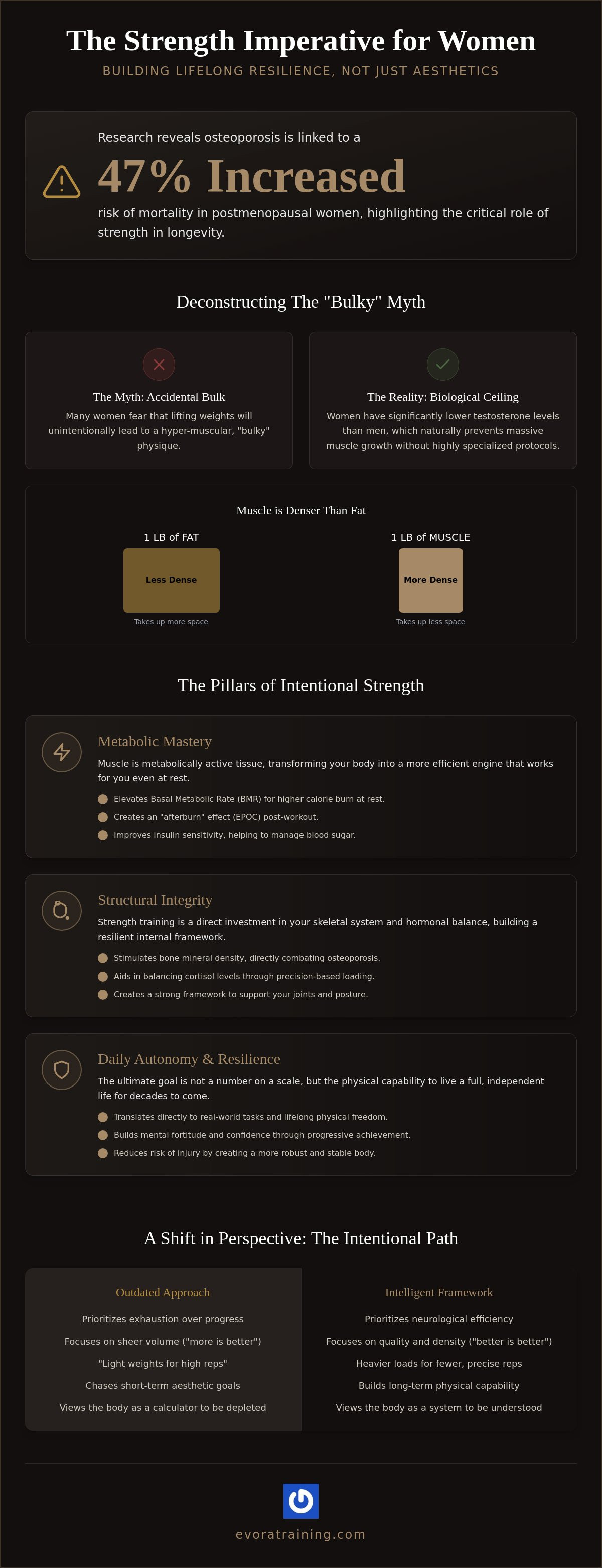
Research from May 2026 reveals that osteoporosis is associated with a 47% increased risk of mortality in postmenopausal women. This statistic is sobering, but it highlights a vital truth about the importance of strength for women that often gets lost in the noise of aesthetic-driven fitness. You might feel under-muscled in your daily life or hesitant to start because you fear high-intensity workouts will leave you injured or hormonally depleted. You’re right to seek a more sophisticated path.
The body is a complex system to be understood, not an enemy to be conquered. This article reveals why intentional strength training is the essential cornerstone of your hormonal health, longevity, and daily autonomy. By moving away from generic templates and toward a framework grounded in human physiology, you can build a more resilient future. We’ll deconstruct common myths, examine the latest data on metabolic health, and outline a structured approach to building bone and muscle that feels both safe and effective.
Many women avoid the weight room because they fear waking up with an unrecognizable, hyper-muscular physique. This anxiety is understandable given how the media portrays high-level athletes. However, this visual outcome is never an accident. It is the result of years of specific, high-volume protocols that most people will never replicate. Understanding the biological importance of strength for women requires looking past these aesthetic outliers to focus on the structural integrity of the body.
The fear of “bulk” often leads women toward repetitive, low-intensity routines that offer little physiological reward. These mainstream methods frequently fail to deliver results because they lack the necessary stimulus to create actual change in the tissue. Instead of viewing muscle as a threat to femininity, we should view it as a compact, high-performance framework. Muscle is much denser than fat; it takes up less space while providing the structural support your skeletal system requires.
The primary driver of significant muscle size is testosterone. Women naturally possess significantly lower levels of this hormone compared to men, which acts as a biological ceiling for massive hypertrophy. While estrogen is often viewed only through the lens of reproduction, it plays a vital role in muscle repair and recovery. Professional female bodybuilders who achieve extreme size typically follow non-typical protocols involving specialized nutrition and supplementation far beyond a standard wellness routine. Toning is actually just building muscle while maintaining a healthy body composition.
The myth of “light weights for high reps” has underserved women for decades. This approach often prioritizes exhaustion over progress. Strength training that utilizes heavier loads for fewer repetitions focuses on neurological efficiency and muscle density rather than sheer volume. This creates a resilient, firm physique without adding excessive mass. This methodology is a rejection of the “more is better” philosophy in favor of “better is better.”
Intentional strength training prioritizes precision and form over ego; it is about the quality of the movement rather than the size of the muscle. When we lift with purpose, we’re building a solid foundation that serves as biological insurance for the future. The importance of strength for women lies in this foundational construction. It is a commitment to maintaining a solid framework that supports your daily life and autonomy for decades to come.
The fitness industry often views metabolism through a narrow lens of depletion. We’re told to move more and eat less, a perspective that treats the body like a short-term calculator rather than a complex biological system. When we discuss the importance of strength for women, we’re really talking about metabolic mastery. Muscle is a metabolically active tissue. It requires a significant amount of energy just to exist on your frame. By increasing your muscle density, you elevate your Basal Metabolic Rate (BMR), ensuring your body works for you even when you’re at rest.
Traditional weight loss advice frequently relies on chronic cardio, which can lead to a cycle of exhaustion and muscle loss. A more sophisticated approach focuses on body recomposition. This is the intentional process of losing fat while simultaneously building the framework of muscle. Understanding the importance of strength for women as a metabolic safeguard allows you to step away from the treadmill and toward a lifestyle that supports long-term health. If you’re ready to move beyond the cycle of chronic cardio, exploring a structured program like EVORA Start can provide the logical exit strategy you’ve been seeking.
Resistance training creates a physiological demand that lasts long after you leave the gym. This phenomenon, known as Excess Post-exercise Oxygen Consumption (EPOC), means your system remains elevated as it repairs and constructs new tissue. Beyond the “afterburn,” muscle acts as a metabolic sponge. It improves insulin sensitivity by providing a massive site for glucose disposal. This process protects against the metabolic dysfunction that often accompanies aging and serves as a primary defense against Type 2 diabetes.
Sarcopenia represents the age-related loss of muscle mass that begins to accelerate in our 30s and 40s. A 2025 study found the prevalence of sarcopenia to be 7.43% in postmenopausal women, highlighting a critical need for early intervention. Building a “muscle reserve” now is essential for maintaining physical autonomy in your 70s. Strength training doesn’t just build muscle; it also helps to slow down bone deterioration by providing the mechanical loading necessary for skeletal health. In this framework, muscle is the organ of longevity.
The importance of strength for women is perhaps most evident in the silent, internal transformations that occur beneath the surface. While our previous sections focused on the visible framework and metabolic efficiency, we must also address the biological architecture that keeps us upright and chemically balanced. For women, physical capability acts as a primary regulator of both skeletal integrity and endocrine health. This is why strength training for hormonal balance is not just a fitness goal; it is a necessity for physiological harmony.
Bones are living tissues that respond to the demands we place upon them. Many women rely solely on calcium or vitamin D to protect against osteoporosis, but these are only the building blocks. The construction itself requires a mechanical stimulus. This principle, known as Wolff’s Law, explains that bone adapts and strengthens in response to the loads under which it is placed. While cardiovascular exercise supports heart health, it rarely provides the specific loading required to increase Bone Mineral Density (BMD) in the hip and spine. Compound movements like squats and deadlifts provide the necessary compression to signal the body to build more resilient bone tissue.
Relying on supplements alone is a passive strategy for a problem that requires an active solution, though you can read more about selecting high-quality products to support your health. To truly protect the skeleton, we must look at the way muscles pull on bone during resistance training. This tension is what triggers osteoblast activity, the process of building new bone cells. Walking and swimming are excellent for movement, but they don’t provide the axial loading that heavy, intentional lifting does. By focusing on foundational movements that challenge the large muscle groups, we create a protective shield around the most vulnerable parts of our frame.
Mainstream fitness often equates progress with exhaustion, pushing women toward high-impact HIIT sessions that can chronically elevate cortisol. For the female HPA axis, this persistent stress can disrupt the delicate balance of progesterone and estrogen, especially during the perimenopause transition. Intentional lifting offers a superior alternative. It provides a controlled, rhythmic stimulus that builds physical resilience without overwhelming the nervous system. By focusing on precision rather than frantic intensity, we offer the body a sense of safety.
Understanding the importance of strength for women in this context means viewing the gym as a place for foundational construction rather than a site for physical punishment. This approach yields Unique benefits at every age, allowing women to navigate hormonal shifts with a sense of calm and physical empowerment. When we lift with intention, we aren’t just building muscle; we’re nurturing a more resilient chemical environment that can better withstand the stressors of daily life.
Physical capability is the ultimate currency of autonomy. Most fitness marketing focuses on the visual, yet the true importance of strength for women lies in the quiet confidence of a body that functions without hesitation. It is the difference between feeling fragile and feeling formidable in your own skin. This transition from aesthetic pursuit to life tool marks the beginning of true physical empowerment. When we stop asking how our bodies look and start asking what they can do, we reclaim our agency.
Daily life is a series of physical demands. Carrying heavy bags, lifting children, or moving furniture are not just chores; they are tests of your biological framework. Strength training reduces the risk of the nagging injuries that often occur during these mundane tasks. By building a resilient system, you ensure that your body remains a reliable partner rather than a source of chronic pain. This is the essence of functional strength. It is the intentional construction of a body that is prepared for the world.
When you master a foundational strength exercise, you are doing more than moving a weight. You are rewriting an internal narrative of limitation. Society often projects a story of inevitable fragility onto women as they age. Strength training is a deliberate rejection of that story. It provides a steady release of dopamine and endorphins that feels grounded and rhythmic rather than frantic. This psychological spillover is profound. A woman who knows she can lift forty pounds off the floor carries herself differently in every environment. She trusts her frame.
Our modern lives are often sedentary, leading to the structural collapse known as “tech neck” or chronic lower back fatigue. A strong posterior chain acts as the internal scaffolding that keeps the spine aligned and the shoulders back. This isn’t about vanity. It is about reducing the daily friction of physical discomfort. Core stability is equally vital, providing the necessary pressure to support pelvic floor health and internal organ alignment. A strong back is the most effective defense against the “shrinking” and postural decline that many accept as a natural part of aging. It is a commitment to standing tall for decades to come.
Strength is the architecture of your independence. It allows you to move through the world with a sense of safety and resilience. If you are ready to stop chasing temporary fixes and start building a lasting framework, you can begin your journey with the intentional programming at EVORA Training.
Beginning a strength practice does not require a leap into the frantic, high-pressure environment of a commercial gym. It requires a deliberate decision to build a solid foundation through intentional movement. The fitness industry often promotes a “more is better” philosophy that leads to depletion and injury. We invite you to embrace a “better is better” approach instead. This is about precision, rhythm, and the long-term importance of strength for women as a means of preserving biological intelligence. You don’t need an array of complex machines to see massive benefits; you only need a commitment to the process of construction.
Your journey should begin with the mastery of four basic movement patterns: the squat, the hinge, the push, and the pull. These are the architectural pillars of human movement. For many, beginner strength training for women should start with bodyweight exercises or light resistance to cement these patterns into the nervous system. Shift your focus away from the scale. Instead, set performance goals that celebrate what your body can achieve. Can you perform a perfect goblet squat? Can you maintain a stable plank? These are the true metrics of progress.
The EVORA method is designed for the woman who views herself as the architect of her own well-being. Our tiered approach begins with EVORA Start, a program that removes the guesswork from foundational development. It is a science-backed, digital-first strategy created for busy women who value substance over aesthetics. We provide the structure; you provide the intention. By following a plan tailored to female physiology, you can stop guessing and start building a framework that will last a lifetime. Join the movement of women building sustainable power with EVORA Training and reclaim your physical autonomy today.
Strength is the silent architect of a life well-lived. We’ve moved past the superficial fear of “bulking” to understand that muscle is actually a compact, metabolically active framework. It protects your bones, balances your hormones, and provides the physical autonomy required to navigate daily life with ease. Recognizing the deep importance of strength for women is the first step in rejecting a fitness industry that often prioritizes temporary aesthetics over long-term biological resilience. It’s about moving from a state of physical uncertainty to one of grounded, measurable progress.
You deserve a path forward that respects your unique physiology and honors your long-term health goals. EVORA Training offers science-backed programs designed to build power without the pressure of an aggressive “shred” culture. This methodology was born from Shannon Moore’s personal 110lb transformation journey, proving that a deliberate, sustainable approach yields the most profound results. You don’t need to conquer your body; you only need to understand it. Begin your intentional strength journey with EVORA Start today. Your future self is waiting for the foundation you build now.
The scale may fluctuate or increase slightly, but this change often reflects a shift in body composition rather than fat gain. Muscle is significantly denser than fat, meaning it takes up less space on your frame while weighing more. Focusing on how your clothes fit or your physical capability provides a more accurate measure of progress than a traditional scale. This is the essence of body recomposition.
Lifting weights is often one of the most effective ways to manage joint pain when done with proper form. Strengthening the muscles surrounding a joint provides better structural support and reduces the mechanical load on the connective tissue itself. Instead of avoiding movement, focus on low-impact, intentional loading. This approach helps lubricate the joints and improves long-term mobility without causing further irritation.
Current health guidelines reaffirmed in 2026 suggest that performing muscle-strengthening activities just two days a week is sufficient to see meaningful improvements. This frequency allows for adequate recovery while still providing the necessary stimulus to build a resilient framework. Consistency is far more valuable than high-intensity sessions that lead to burnout. A steady, twice-weekly rhythm supports the importance of strength for women without overwhelming the nervous system.
You can absolutely build a solid foundation at home using bodyweight movements or simple resistance bands. The body doesn’t distinguish between a high-end machine and the mechanical tension created by a well-executed squat or push-up. Mastering movement patterns is the priority. Once you’ve established form, you can introduce external loads using common household items or affordable dumbbells to continue your progress.
It’s never too late to begin, and for women over 50, strength training is a biological necessity. Research from January 2026 indicates that osteoporosis affects 18.8% of women in this age group. Intentional lifting is the most effective tool to slow bone deterioration and combat sarcopenia. Starting now allows you to preserve your physical autonomy and build a protective reserve for the decades ahead.
Toning is largely a marketing term used to describe the visibility of muscle through a healthy body composition. In biological terms, you are either building muscle tissue or maintaining it; there is no specific toning exercise. Strength training provides the stimulus to create a firm, compact framework. When you combine this with intentional nutrition, you achieve the defined look that mainstream industry tropes often mislabel.
Adequate protein is essential for muscle repair and hormonal health, but you don’t need an excessive or aggressive intake to see results. Consuming a balanced amount of high-quality protein helps support the construction of new tissue after a workout. Instead of following extreme protocols, focus on consistent, moderate portions. This nurturing approach ensures your body has the building blocks it needs for maintenance and growth.
You don’t need to stop your practice, but you should learn to adjust your intensity based on your internal rhythm. During certain phases of your cycle or periods of high stress, your body may require a more restorative stimulus. Instead of skipping a session, try reducing the weight or focusing on mobility. This maintains the habit of movement while respecting the importance of strength for women as a tool for long-term wellness.