
By January 2026, the CDC reported that nearly 19% of women aged 50 and over in the United States were diagnosed with osteoporosis. This news often brings a quiet fear of becoming fragile or a deep anxiety about losing independence. You likely understand that movement is necessary, yet you may find yourself caught between the gentle suggestion of walking and the intimidating world of high-intensity gyms. Effective strength training for bone density women requires a shift in perspective. It is a process of construction rather than a pursuit of exhaustion.
Your skeleton is not a static frame; it is a living, responsive architecture. This article introduces a science-backed framework designed to help you build bone density through intentional mechanical loading. We will move past the confusion of traditional resistance training to focus on a logical, long-term path for skeletal health. You will discover how to nurture your body’s foundation and replace the fear of fragility with the quiet confidence of a solid, lasting framework. It is time to treat your body as a complex system to be understood and maintained.
Your skeleton is not an inert frame. It is a dynamic, living tissue that constantly remodels itself in response to the demands you place upon it. Bone mineral density (BMD) serves as a vital metric of this internal architecture, reflecting the concentration of minerals, primarily calcium and phosphorus, within your bone segments. High density signifies a robust, resilient structure, while low density indicates a framework that has become porous and vulnerable. Viewing your bones through this architectural lens allows you to move away from the fear of aging and toward a strategy of intentional maintenance.
Medical professionals often refer to bone loss as the “silent thief” because the process is entirely asymptomatic. You cannot feel your bones thinning; there is no ache or warning sign as the internal scaffolding weakens. Frequently, the first clinical symptom is a fragility fracture resulting from a minor fall or even a forceful sneeze. This reality is reflected in 2026 CDC data, which shows that 18.8% of women aged 50 and over in the U.S. have already developed osteoporosis in the femur neck or lumbar spine. Identifying these changes before a crisis occurs is the primary goal of skeletal health management.
The dual-energy X-ray absorptiometry (DEXA) scan remains the gold standard for measuring this hidden integrity. It provides a T-score that compares your bone density to that of a healthy young adult. This measurement is not a final verdict but a blueprint for action. While the “fragility myth” suggests that bones inevitably become brittle with age, the reality is one of remarkable adaptability. By engaging in targeted strength training for bone density women, you provide the mechanical signal necessary for your body to reinforce its own structure.
Bone loss exists on a spectrum of severity. Osteopenia represents the warning phase, where bone density is lower than normal but not yet at a critical level of fracture risk. It is a vital window of opportunity. Transitioning into osteoporosis means the bone has become significantly porous and brittle, increasing the likelihood of life-altering injuries. Initiating a protocol for beginner strength training women during the osteopenic phase can often halt or even reverse the trajectory toward more severe degradation.
Estrogen acts as a protective foreman for your skeletal architecture, regulating the balance between bone removal and new construction. During perimenopause and menopause, estrogen levels decline sharply, disrupting this equilibrium and allowing the demolition process to outpace repair. Bone resorption is the physiological process where bone tissue is broken down and its minerals are released into the blood, a cycle that often accelerates beyond the rate of new formation during the 1% annual bone loss women typically experience after age 40. This biological shift makes strength training for bone density women a non-negotiable tool for maintaining long-term independence. To complement your physical training with targeted nutritional strategies for this life stage, learn more about Evabiotic and their clinical approach to hormonal resilience.
Bone is not a finished product. It is a work in progress. This biological reality is governed by Wolff’s Law, which states that your bones will adapt to the specific loads you place upon them. When you subject your skeleton to mechanical stress, it doesn’t break; it reinforces itself. This isn’t a vague or mystical occurrence. It is a precise cellular response known as mechanotransduction. Through this process, your bone cells, or osteocytes, act as internal sensors that detect physical pressure and signal the body to begin a process of fortification.
Many women are told that walking is sufficient for skeletal health. While walking supports cardiovascular function, it often lacks the necessary force to trigger significant bone remodeling. There is a fundamental difference between simple weight-bearing movement and true mechanical loading. Research from Michigan State University confirms that resistance exercise is a beneficial activity for bone health because it creates the high-magnitude tension required to stimulate growth. To build a resilient frame, the skeleton needs the powerful pull of muscle against bone that only intentional lifting provides.
The most effective stimulus for this growth comes from the tension generated during muscle contraction. As your muscles work to move a weight, they tug on the tendons attached to your bones. This tugging creates a microscopic deformation in the bone tissue. This isn’t damage. It’s a signal. It tells your body that the current structure is insufficient for the environment, prompting an architectural upgrade. For those looking to begin this journey safely, exploring a structured program like EVORA Start can provide the necessary guidance to apply these loads effectively.
Inside your bones, two primary types of cells manage the construction process. Osteocytes sense the stress of strength training for bone density women and then recruit osteoblasts to the site. These osteoblasts are the builders. They lay down a new mineral matrix, filling in porous areas and increasing the overall thickness of the bone. This process is highly site-specific. If you want to strengthen your hips and spine, you must choose movements that directly load those areas. General movement won’t suffice; you need targeted, architectural precision.
As estrogen levels decline during menopause, the natural protection of your skeleton fades. However, mechanical loading can serve as a powerful surrogate. By engaging in strength training for hormonal balance, you create a secondary system of protection. You aren’t just “working out.” You are using physical capability as a tool to mitigate physiological shifts. This synergy allows you to maintain skeletal integrity even when your hormonal landscape changes. It is a shift from relying on biology to actively constructing your own longevity through strength training for bone density women.
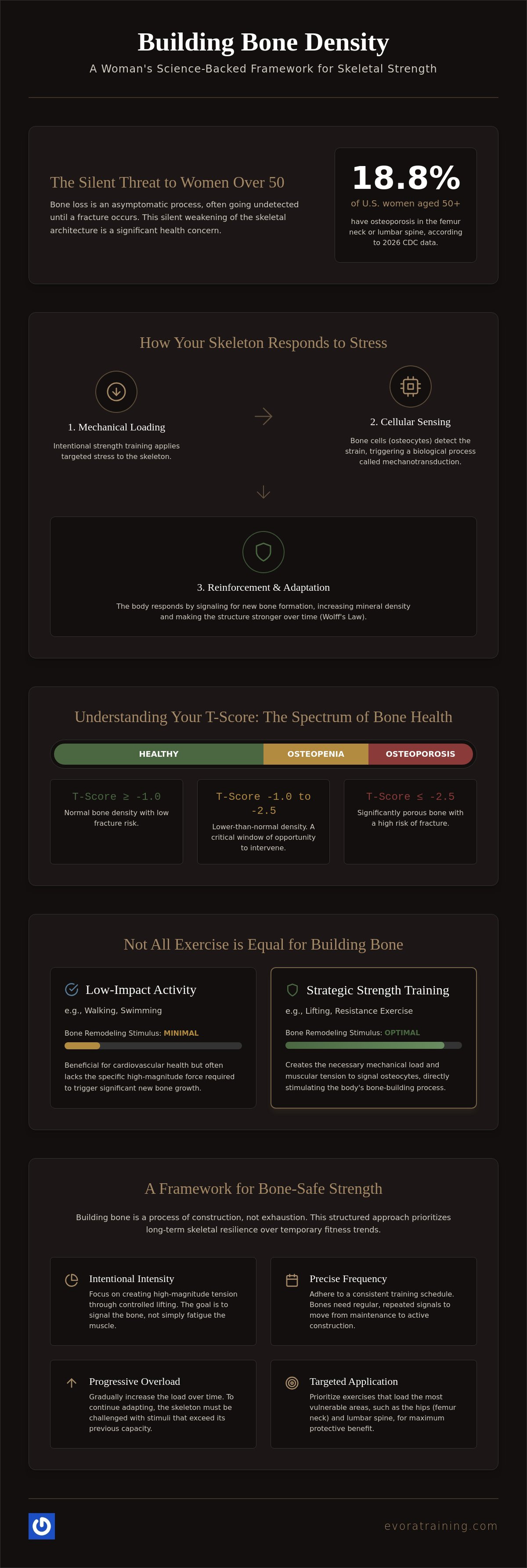
Activity is often conflated with adaptation. You might spend hours cycling or swimming, believing these movements protect your skeleton. While these pursuits offer immense cardiovascular value, they fail to provide the gravitational load necessary for bone construction. Buoyancy and smooth rotations don’t challenge the internal scaffolding. To build a lasting framework, you must apply a specific type of stress that exceeds your daily baseline. Research on Strength training for women and bone health demonstrates that skeletal tissue only responds when a biological threshold is met.
This threshold is known as the Minimum Essential Strain (MES). Think of it as the “ignition point” for bone growth. If the mechanical force applied to the bone is too light, the osteoblasts remain dormant. Strategic strength training for bone density women requires moving beyond random acts of fitness and toward a hierarchy of loading. While high-impact activities like jumping provide excellent stimulus, they can be risky for those with existing low density. Controlled resistance training offers a superior alternative, providing high-magnitude stress with a much lower risk of injury.
Structure is the antidote to fragility. Engaging in a sequence of movements without a specific goal often leads to plateaued results and wasted effort. A deliberate protocol ensures that you are consistently hitting the MES without overtaxing your recovery systems. This architectural approach shifts the focus from “staying busy” to “building density.”
Isolation exercises have their place, but compound movements are the primary tools for skeletal fortification. Squats, deadlifts, and overhead presses engage multiple joints and large muscle groups simultaneously. This creates a systemic loading effect that specifically targets the most vulnerable areas: the hips, spine, and wrists. When you prioritize these lifts, the process of body recomposition for women naturally supports bone density by increasing the lean mass that pulls against your skeleton. To enhance this journey with premium nutritional support, you can discover GREENDO and their range of natural supplements for active women. You aren’t just changing how you look; you’re reinforcing your internal foundation.
Your bones are intelligent; they won’t continue to adapt to a stressor they’ve already mastered. Lifting the same five-pound dumbbells for years provides a maintenance signal at best. To trigger continuous remodeling, you must gradually increase the “intentional stress” placed on your system. This is the essence of progressive overload for women. By carefully increasing weight, volume, or intensity over time, you ensure that your strength training for bone density women remains an effective catalyst for skeletal growth rather than a stagnant routine.
Effective strength training for bone density women is not about daily depletion but about providing a clear, rhythmic signal for growth. A sustainable protocol requires a balance between intentional stress and deep recovery. For most women, the “sweet spot” for bone remodeling is two to three sessions per week. This frequency allows for the necessary mechanical loading to trigger adaptation without overtaxing the central nervous system or the joints. Consistency in this rhythm serves as the foundation for your long-term skeletal architecture.
Intensity is the primary driver of this adaptation. To move beyond maintenance and into active construction, you should aim to work at 70% to 85% of your maximum capacity. This level of effort ensures that the mechanical strain is high enough to wake up the osteoblasts. While intensity is vital, it must never come at the expense of integrity. Proper form acts as the insurance policy for your joints, ensuring that the load is directed exactly where it belongs: into the bone and muscle tissue rather than the connective structures.
Recovery is where the actual fortification happens. While the training session provides the signal, the rest period is when the bone matrix “hardens” and reinforces itself. Skipping rest days doesn’t accelerate progress; it disrupts the building process. By respecting the recovery phase, you allow your body to complete the biological cycle of resorption and formation. This patient, structured approach is what separates a professional framework from the high-pressure, unsustainable methods common in the fitness industry. For men navigating the unique exhaustion of long shifts, Blue Collar Fit offers a pragmatic fitness blueprint designed for the 12-hour workday.
In the context of skeletal health, not all repetitions are equal. While high-repetition sets build muscular endurance, moderate to heavy weights in the five to ten rep range are far more effective for increasing bone density. This range allows you to use weights that are heavy enough to create the necessary Minimum Essential Strain. To gauge this intensity, use the Rate of Perceived Exertion (RPE) scale. For bone health, an RPE of 7 or 8 means you feel you could perform only two or three more quality repetitions before your form begins to shift.
You don’t need a commercial weight room to construct a resilient skeleton. The efficacy of strength training for women at home depends on your ability to create intentional load rather than the size of your equipment. Essential tools like dumbbells, resistance bands, and even structured bodyweight progressions can provide sufficient stimulus if applied with precision. The goal is to ensure the skeleton feels a challenge it hasn’t mastered yet. If you’re looking for a guided entry point into this architectural approach, EVORA Start provides a bone-safe foundation that you can build from the comfort of your own space.
Mainstream fitness often treats the female body as an enemy to be conquered through depletion. It focuses on the temporary metrics of calories burned and sweat produced. The EVORA approach rejects this cycle of exhaustion in favor of a superior alternative: the intentional construction of a resilient frame. We view your body as a complex system to be understood and nurtured rather than a problem to be solved. By shifting the focus from burning to building, strength training for bone density women becomes a logical, long-term strategy for physical independence. EVORA Start provides the initial architectural blueprint for this work, ensuring your foundation is secure before you add more complex layers of load.
Biological intelligence is at the heart of our methodology. Bone health is inextricably linked to your hormonal landscape, and ignoring this connection leads to frustration and injury. An effective female strength training program must be hormone-aware, adapting to the specific physiological shifts that occur during perimenopause and beyond. This precision allows you to move from a state of perceived fragility to one of fortress-like strength. You aren’t just lifting weights; you’re reinforcing the living architecture that carries you through life.
Progression must be deliberate to be safe. Our tiered system—Start, Essentials, and Elite—ensures that your skeleton adapts at a pace that respects its biological limits. This structured path removes the anxiety of the unknown. There is a profound psychological benefit to knowing your plan is grounded in scientific authority rather than industry trends. This sense of security is a key component of strength training for mental health women. When you trust the process, you can focus on the measurable progress of your own development.
Investing in your bone density today provides a high return on investment for your future independence. Each intentional session is a deposit into your long-term physical capability. While the visual outcomes of strength training for bone density women are a welcome byproduct, the true value lies in the freedom to move without fear. This physical independence allows you to stay active in all areas of life, including adventuring with your dog; for those seeking professional tools for their pet, you can discover Educator Collars to enhance your training journey. Joining the EVORA community means partnering with experts who are deeply invested in your well-being. It is never too late to begin the process of construction. Your skeletal architecture is waiting for the signal to grow; you only need to provide the framework.
Your skeleton is not a fixed structure destined to fail; it is a living architecture capable of profound adaptation. By moving beyond the fear of fragility and embracing a science-backed framework, you take control of your long-term capability. We have explored how mechanical loading triggers cellular remodeling and why compound movements are the gold standard for skeletal integrity. This shift toward intentionality allows you to replace anxiety with a logical path forward that focuses on construction over depletion.
Effective strength training for bone density women isn’t about physical punishment. It’s about a hormone-smart approach that respects your unique biology. This philosophy is at the core of everything we do at EVORA. Grounded in Shannon Moore’s personal 110-pound transformation, our digital programs provide the precision needed to build a fortress-like foundation from your home or gym. You have the intelligence to understand your body and the power to maintain it through every stage of life.
Ready to build a foundation that lasts? Explore the EVORA Start Program and begin your journey toward a life of lasting strength. It’s never too late to start the work of construction.
Walking provides excellent cardiovascular benefits, but it is generally insufficient to trigger significant bone remodeling. It lacks the high-magnitude mechanical loading needed to activate osteoblasts, the cells responsible for building new bone matrix. To build a truly resilient frame, you must move beyond simple weight-bearing activities and introduce the intentional stress of resistance training. This mechanical pull is what signals the skeleton to reinforce its internal architecture.
You can absolutely build bone density after an osteopenia diagnosis. Bone is a dynamic, living tissue that adapts to the mechanical environment you create for it. By applying a science-backed framework of intentional loading, you signal your internal construction crew to reinforce the skeletal matrix. Starting a protocol during this warning phase is a proactive strategy to halt thinning and prevent a transition into more severe bone loss.
Lifting weights two to three times per week is the ideal frequency for skeletal adaptation. This rhythm provides the necessary stimulus for growth while allowing your bones the time they need to “harden” and recover between sessions. Consistency is far more valuable than intensity in this context. A steady, deliberate practice ensures your skeleton remains in a state of active construction rather than stagnation.
Lifting weights heavy enough to build bone will not result in a bulky physique. Most women lack the hormonal profile required for massive muscle hypertrophy; instead, this type of training builds dense, compact structures. This approach shifts the focus from purely visual outcomes to physical capability. Through strength training for bone density women, you aren’t just changing your shape; you are constructing a fortress-like internal framework that supports your daily life.
Compound movements like squats and deadlifts are the most effective exercises for hip bone density. These lifts provide the site-specific loading required to strengthen the femur neck and pelvis. By engaging large muscle groups that pull directly on the hip joint, you create a powerful signal for bone remodeling. Precision in form is essential to ensure the stress is directed into the bone rather than the connective tissues.
It is both safe and highly beneficial to begin strength training after age 60. While the 2025 USPSTF guidelines recommend screening at age 65, proactive training can begin at any age to mitigate fracture risk. An intentional, hormone-smart program allows you to build foundational strength safely, regardless of your starting point. You are never too old to replace a fear of fragility with a new architecture of longevity.
Heavy gym machines are not a requirement for improving bone mineral density. You can achieve excellent results using dumbbells, resistance bands, or progressive bodyweight movements in a home setting. The key is creating an intentional load that challenges your current skeletal capacity. A structured digital program allows you to build a resilient frame in whatever environment feels most comfortable and sustainable for you.
Measurable improvements in bone density typically require six to twelve months of consistent effort. Bone remodeling is a slow, rhythmic biological process that cannot be rushed through intensity alone. While you will likely feel stronger and more stable within weeks, the actual hardening of the skeletal matrix requires patience. This long-term ROI is why we prioritize a sustainable, lifetime approach to strength training for bone density women.