What if the most sophisticated tool for your long-term health isn’t more movement, but more resistance? For years, the fitness industry has prescribed a cycle of high-intensity exhaustion and generic “toning” advice that leaves many women feeling underserved and depleted. You’ve likely felt the frustration of working harder without seeing the structural resilience you desire. It’s time to reject the idea that your body is an enemy to be conquered through punishment. Understanding the true benefits of lifting heavy for women allows you to transition from a state of depletion to one of deliberate construction. By 2050, projections suggest nearly 60% of women in the U.S. will face high blood pressure, and one in four women over 65 already struggle with osteoporosis. These aren’t just statistics; they’re architectural warnings.
This article offers a logical path forward. You’ll discover how intentional heavy resistance training serves as a precise tool for hormonal health, metabolic longevity, and the functional strength required for a vibrant life. We’ll explore five life-changing shifts that happen when you stop chasing fatigue and start building a foundation that lasts. It’s a journey from temporary fixes to a sustainable physical transformation grounded in biological intelligence.
Mainstream fitness culture often promises a “toned” aesthetic through endless repetitions of light weights. This approach views the female body as something to be shrunk rather than built. In reality, the benefits of lifting heavy for women stem from a commitment to structural integrity. When we speak of “heavy” lifting, we aren’t referring to an arbitrary number on a barbell. We are defining it as relative intensity. This means challenging your unique physiological threshold to trigger a meaningful biological response. It’s a shift from merely moving to intentionally constructing.
Think of your body as a complex architectural system. A house requires a solid frame to support the weight of the roof and withstand the elements. Without that internal framework, the structure eventually sags. Muscle tissue is that frame for your life. While light weights may offer some cardiovascular stimulus, they often fail to provide the mechanical tension necessary for true skeletal and muscular maintenance. Engaging in Strength training isn’t about physical punishment. It’s about providing the high-quality materials your body needs to remain upright and resilient for decades.
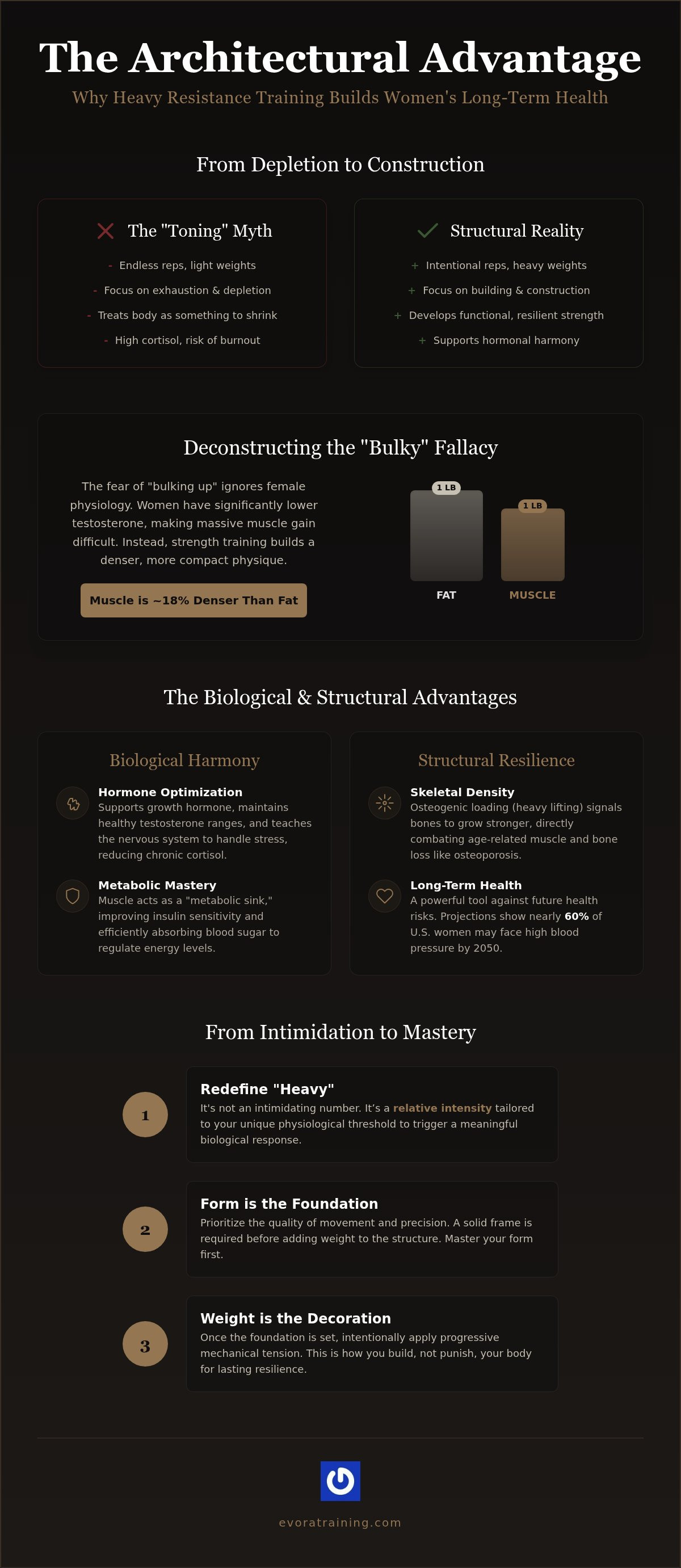
The fear of “bulking” is a persistent industry trope that ignores female endocrinology. Women possess significantly lower levels of testosterone than men, making massive muscle hypertrophy difficult to achieve without extreme, specialized interventions. Instead, estrogen and progesterone act as regulators that prioritize tissue repair and metabolic health. Muscle is approximately 18% denser than fat tissue. By replacing softer tissue with dense muscle, you create a refined, compact silhouette. Hypertrophy is the physiological process where muscle fibers increase in volume in response to progressive mechanical tension. This growth results in a firm, functional framework rather than unwanted bulk.
Mainstream habits often prioritize “intensity” as a measure of success. They value the sweat, the exhaustion, and the feeling of being depleted. Intentionality offers a superior alternative. It focuses on the quality of the movement and the precision of the load. When you lift with intent, you aren’t just moving a heavy object from point A to point B. You are carefully applying stress to specific tissues to encourage growth and longevity. This approach moves you away from punishing the body and toward nurturing its potential. If you’re ready to start this process, exploring a Beginner Strength Training for Women guide can help you establish the correct architectural basics from day one.
Mainstream fitness templates often treat the female body as a smaller version of the male one. This oversight ignores the intricate endocrine landscape that defines our health. One of the most significant benefits of lifting heavy for women is how it integrates with our unique biological rhythms rather than fighting against them. While generic high-intensity programs often lead to burnout, intentional resistance training fosters a state of physiological harmony. It supports the production of growth hormone and maintains testosterone in healthy, functional ranges without the risk of virilization. This creates a balanced internal environment where your body can thrive.
Heavy lifting also serves as a sophisticated tool for managing stress. Chronic, repetitive cardio can frequently lead to elevated cortisol levels, which may interfere with sleep and recovery. In contrast, heavy resistance training provides a controlled, intentional stressor. This teaches your nervous system to handle pressure more effectively. By focusing on building rather than depleting, you move toward a “hormone-smart” fitness model that rejects the one-size-fits-all approach of the past.
Your muscle tissue acts as a primary “metabolic sink” for glucose. When you engage in heavy resistance, your muscles become more sensitive to insulin, allowing them to absorb blood sugar more efficiently. This is a critical benefits of strength training for women, especially for those managing conditions like PCOS or general insulin resistance. Unlike steady-state cardio, which primarily uses energy during the activity itself, muscle tissue increases your resting metabolic rate (RMR). Consider these metabolic advantages:
You aren’t just burning energy for sixty minutes; you’re building a system that requires more energy to maintain itself. It’s a long-term investment in metabolic longevity. If you’re looking for a structured way to begin this journey, EVORA Start provides a logical entry point that respects these physiological nuances.
A truly empathetic approach to fitness recognizes that your strength needs fluctuate. During your follicular phase, rising estrogen levels often provide a window of increased power and recovery capacity. This is the time to lean into your physiological strengths. During the luteal phase, your body may require a shift toward maintenance and nurturing. Listening to this internal wisdom prevents the cycles of exhaustion common in traditional methods. For a deeper look at this process, you can explore our guide on Strength Training for Hormonal Balance.
Building a resilient framework requires more than just burning calories. It demands a strategic approach to structural health that recognizes the body as an integrated system. One of the most vital benefits of lifting heavy for women is the proactive prevention of sarcopenia, the age-related loss of muscle mass that can begin as early as our thirties. While generic fitness templates often focus on temporary weight shifts, intentional resistance training acts as a powerful intervention for your future self. By maintaining muscle tissue now, you ensure your joints and connective tissues remain integrated and capable of supporting your daily life well into your later years.
Heavy lifting is often safer for aging joints than high-impact aerobic activities. Running and jumping place repetitive, jarring stress on the skeletal system, whereas controlled resistance training provides a steady, manageable load. This process strengthens the ligaments and tendons that hold your structure together. It is a shift from high-impact depletion to low-impact construction. You aren’t just exercising; you’re reinforcing the very foundation of your physical autonomy.
The transition into menopause brings a significant decline in estrogen, which can lead to rapid bone loss. Some women lose up to 25% of their bone mass in the first ten years after menopause, and current data shows that one in four women aged 65 or older in the U.S. is affected by osteoporosis. Light weights often fail to provide the mechanical tension required to trigger osteoblasts, the cells responsible for building new bone. According to a comprehensive scientific review, osteogenic loading through heavy resistance is the most effective way to stimulate bone mineral density. Your grip strength is a biological handshake with your future self, signaling the vitality of your entire nervous system and skeletal integrity.
Heavy resistance training encourages the development of a “functional corset.” Compound movements require the deep stabilizers of the core to work in unison, creating a foundation of support for your spine. While high-impact stress can sometimes weaken the pelvic floor, heavy lifting performed with proper form actually nurtures pelvic health by teaching the body to manage intra-abdominal pressure effectively. This structural reinforcement improves your posture and reduces the likelihood of chronic back pain. You are building a framework that carries you through every life stage with quiet confidence rather than a sagging structure that requires constant repair.
Mastering heavy resistance is a process of refinement. It requires a fundamental shift in perspective. Instead of viewing the weight room as a place of physical punishment, see it as a workshop for structural development. The first rule of this mastery is simple: form is the architecture; weight is the decoration. Without a sound architectural foundation, adding weight only compromises the integrity of the system. You must prioritize the quality of the movement before you increase the load.
Selecting your starting weights shouldn’t be a source of anxiety. Begin with a load that allows you to complete your repetitions with technical precision. One effective tool for this is the Rate of Perceived Exertion (RPE) scale. On a scale of one to ten, aim for an effort level of seven or eight. This ensures you are accessing the benefits of lifting heavy for women without overextending your current capacity. It allows for a challenging stimulus that remains within the bounds of safety and control.
Progressive overload is the gradual increase of stress placed upon the body during exercise. It isn’t a race to the heaviest dumbbell in the rack. It’s a nurturing process. By slowly increasing repetitions, adding weight, or improving your movement tempo, you provide the consistent stimulus needed for tissue construction. Tracking these metrics in a log allows you to see progress that the scale often hides. Focus on the measurable growth of your capabilities rather than a fluctuating number on a bathroom floor.
Many women feel underserved by the high-pressure environment of commercial gyms. Learning the architecture of strength in your own space offers a unique level of psychological safety. You don’t need a warehouse of equipment to see results. A pair of dumbbells or a single kettlebell can provide a sufficient stimulus for foundational growth. If you’re ready to begin, our guide on Strength Training for Women at Home offers a structured path for the modern professional.
Building a resilient body requires an honest dialogue with your physiology. You must learn to distinguish between the “good” fatigue of muscular work and the “bad” signal of joint pain. Muscle soreness is a sign of repair and adaptation. Sharp joint pain is a signal to adjust your form or load immediately. Recovery and sleep are not passive breaks from your goals. They are active components of the architectural plan. Rest days are the moments when your body actually builds the tissue you’ve stimulated during your sessions. To start building your framework today with a program that respects your recovery, explore EVORA Start.
EVORA represents a departure from the aggressive, high-pressure messaging of the mainstream fitness industry. We offer a sophisticated alternative grounded in scientific authority and deep-seated empathy. Our methodology views the body not as an enemy to be conquered, but as a complex system to be understood and nurtured. This is the core of the EVORA philosophy: a commitment to intentional, science-backed, and empathetic training. It’s a partnership that prioritizes your long-term well-being over the temporary fixes offered by generic fitness templates.
Shannon Moore founded this framework after her own 110-pound transformation. She realized that the standard industry prescriptions of high-intensity cardio and extreme depletion often fail to address the specific physiological needs of women. Her personal narrative of transformation adds a layer of authenticity to the clinical research we utilize. By focusing on the biological benefits of lifting heavy for women, she developed a structured approach that respects hormonal health and structural integrity. This isn’t about physical punishment; it’s about measurable progress and the steady construction of a resilient frame.
Digital training provides the autonomy and structure that modern women require. It allows you to build your framework in a space where you feel safe and focused. Our tiered programs—EVORA Start, EVORA Essentials, and EVORA Elite—ensure that you have a logical progression regardless of your current experience level. You move from foundational mastery to advanced resilience at a pace that respects your unique physiology. This sequential flow moves you from a state of frustration to one of empowered action.
The journey begins with EVORA Start. This program focuses on foundational movements before any significant load is added. We prioritize intentional repetitions to ensure long-term joint safety and skeletal health. This is a deliberate rejection of the “no pain, no gain” culture that often leads to injury and burnout. Instead of punishing the body, we focus on nurturing its potential through precision-based programming. It’s the logical first step for any woman transitioning from cardio-heavy habits to a strength-based lifestyle.
We invite you to view your body as an architectural masterpiece in progress. It’s a system that deserves precision, rhythm, and longevity. The transition from exhaustion to empowered action begins with a single, intentional choice. You don’t have to settle for generic advice that leaves you underserved. You can choose a path that honors your biology and builds a foundation for a vibrant life. Explore our Female Body Transformation Program to discover how a hormone-smart approach can redefine your strength. It’s time to stop chasing fatigue and start building your framework for lasting power.
The journey from physical depletion to structural resilience begins with a fundamental shift in perspective. You’ve seen how the benefits of lifting heavy for women extend far beyond superficial aesthetics, offering a precise tool for hormonal harmony and skeletal integrity. By rejecting generic, high-pressure templates and embracing intentional resistance, you move toward a state of biological intelligence. This approach is not about punishing your body; it’s about nurturing its architecture for the decades ahead.
EVORA was founded on Shannon Moore’s personal 110-pound transformation journey. It offers science-backed modules tailored specifically to female physiology, avoiding aggressive jargon in favor of clear, architectural progress. You deserve a method that values your autonomy and your long-term vitality. It’s time to stop chasing exhaustion and start building a foundation that lasts. Begin your intentional strength journey with EVORA Start today. Your body is a complex system waiting for the right architect. Trust the process and embrace your lasting power.
No, lifting heavy will not make you look masculine. Women possess significantly lower testosterone levels than men, making massive hypertrophy difficult to achieve without extreme, specialized intervention. Instead, you’ll build dense muscle tissue that creates a compact, refined silhouette. This structural development supports your metabolism and skeletal health without adding unwanted bulk. It’s about building a firm, functional framework that respects your natural physiology.
Most women see the significant benefits of lifting heavy for women by training two to three days per week. This frequency allows for the necessary mechanical tension to trigger growth while providing ample time for tissue repair and recovery. Consistency matters more than daily intensity. By following a structured, tiered program, you ensure that every session contributes to your long-term architectural progress without leading to systemic exhaustion.
You can absolutely start lifting heavy if you’re new to exercise. The key is to begin with foundational movements to establish proper movement patterns before adding significant load. In the EVORA Start program, we focus on the architecture of the lift to ensure your joints and connective tissues are prepared. Starting with a focus on form creates a safe, logical path from intimidation to mastery for any beginner.
It’s not only safe but highly recommended to lift heavy during perimenopause. As estrogen levels begin to fluctuate and decline, your bone density and muscle mass face increased risks. Heavy resistance training provides the essential stimulus for bone building cells to maintain skeletal integrity. It acts as a protective intervention against the metabolic and structural shifts that occur during this transition, serving as a vital tool for future-proofing your health.
“Toning” is a marketing term often used to describe high repetition, low weight exercises that rarely challenge your physiological threshold. Lifting heavy involves using a relative intensity that triggers a genuine biological response. While toning often leaves the underlying structure unchanged, heavy lifting builds the dense muscle tissue required for a refined aesthetic and metabolic longevity. It’s the difference between a temporary surface fix and a lasting structural transformation.
You don’t need a commercial gym membership to experience the structural benefits of resistance training. Many women find success using dumbbells or kettlebells in the privacy of their own homes. Digital programs provide the necessary structure and guidance to ensure your form is correct and your progress is measurable. This approach offers the autonomy and psychological safety that busy professionals often require to remain consistent with their long-term goals.
A weight is heavy enough when it challenges your unique physiological threshold. We recommend using the Rate of Perceived Exertion (RPE) scale to measure this. On a scale of one to ten, your working sets should feel like a seven or an eight. This means you could perform perhaps two more repetitions with perfect form, but no more. It’s a subjective measure that respects your energy levels and biological rhythm.
Yes, heavy lifting is an effective tool for managing hormonal imbalances such as PCOS. Muscle tissue acts as a metabolic sink for glucose, which significantly improves your insulin sensitivity. By building more muscle, you help your body regulate blood sugar more efficiently. This hormone-smart approach focuses on construction rather than the depletion often caused by chronic cardio. It’s a rational way to support your endocrine system through intentional, science-backed movement.