

What if the exhaustion you feel after a grueling hour of cardio isn’t a badge of honor, but a signal of systemic depletion? Many women are taught that fitness requires physical punishment, yet only about one in five adults currently meets the recommended guidelines for health. You’ve likely felt the pressure to choose between a demanding professional schedule and the 30 minute strength workout women need to build real, sustainable power. This cycle of high-intensity burnout often does more to spike cortisol than it does to build lasting capability. It’s time to reject the idea that more time always equals more progress.
Choosing a focused approach isn’t about cutting corners; it’s about prioritizing biological intelligence over mindless movement. You can achieve visible muscle tone and functional power by shifting your focus from the duration of the timer to the intentionality of the load. This article explores how to construct a sustainable routine that nurtures your hormonal health while delivering measurable progress without the fatigue of traditional programs. We’ll move past the confusion of generic templates to find a rhythm that supports your life rather than draining it.
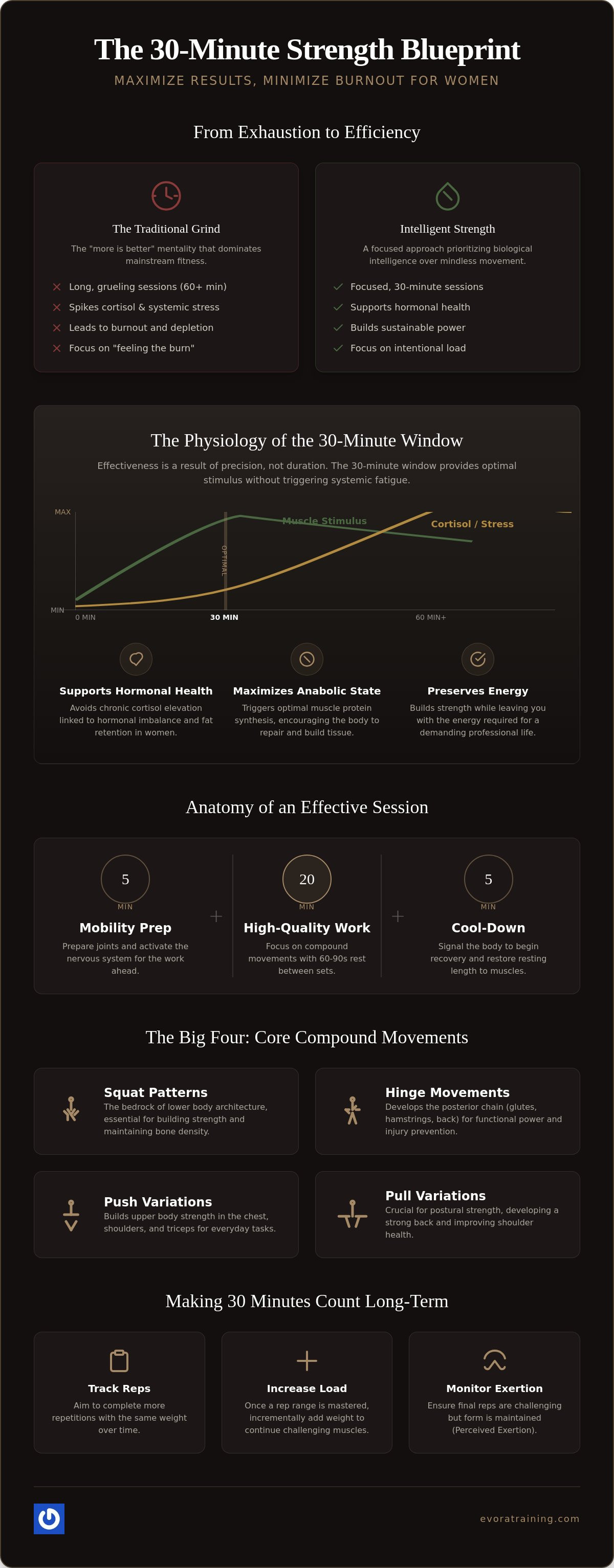
Effectiveness isn’t a byproduct of duration; it’s a result of precision. For many, the gym is a place of endurance, yet the most profound changes happen within a much smaller window. A 30 minute strength workout women choose to follow should prioritize the optimal stimulus for muscle protein synthesis. This timeframe allows you to challenge the musculoskeletal system without crossing into the territory of systemic depletion. By focusing on the foundations of strength training, you trigger a growth response while preserving the energy required for your professional and personal life. This is biological efficiency in action. It rejects the idea that you must be exhausted to be successful. Instead, it views the body as a complex system requiring a specific, measured input to thrive. We must move away from the “more is better” mentality that dominates mainstream fitness and embrace a strategy of intentionality.
Traditional fitness culture often suggests that if a little is good, more must be better, but this logic fails when applied to female physiology. Sessions that exceed the 60-minute mark often shift the body from a state of building to a state of stress. For women, chronic cortisol elevation is frequently linked to hormonal imbalances and stubborn fat retention. A shorter, more deliberate session supports insulin sensitivity and metabolic health without overwhelming the endocrine system. Staying within this focused window ensures you remain in an anabolic state, where the body is encouraged to repair rather than protect and store. Precision in timing allows for a recovery profile that fits into a demanding career. It’s about working with your biology instead of fighting against it. When you respect these hormonal boundaries, you create a sustainable environment for long-term health.
Many popular programs rely on “feeling the burn” as a measure of success, which is a misleading metric for progress. High-intensity interval training (HIIT) frequently prioritizes metabolic conditioning, which focuses on cardiovascular demand rather than structural development. While movement is valuable, it isn’t a substitute for true resistance training. Intentional strength is the deliberate application of load to specific muscle groups to foster long-term structural integrity. By rejecting junk volume, the extra sets that add fatigue without adding benefit, you can focus on movements that build actual capability. This means every rep serves a purpose. You aren’t just using energy; you’re constructing a foundation of power that supports your skeletal structure. Visible muscle tone becomes a natural consequence of this structural focus, rather than a byproduct of depletion.
Construction begins with a blueprint, not a guess. To maximize your time, you must move away from the chaotic “circuit” style workouts often found on social media and embrace a structured, architectural approach. A 30 minute strength workout women can rely on for long-term results is divided into three distinct phases: five minutes of mobility to prepare the joints, twenty minutes of high-quality work, and five minutes of foundational cool-down to signal the body to begin recovery. This structure respects your biology. It ensures that you aren’t just moving, but building. Recent research on short workout effectiveness indicates that even limited weekly sessions can significantly improve longevity and metabolic health when performed with consistency.
Efficiency is found in the 80/20 rule. In strength training, twenty percent of exercises deliver eighty percent of the results. These are compound movements that engage multiple muscle groups simultaneously. By prioritizing these “Big Four” patterns, you create a profound physiological stimulus in a fraction of the time. Rest intervals are equally vital. While it’s tempting to rush, taking 60 to 90 seconds of rest between sets is essential. This pause allows your ATP stores to replenish, ensuring you can lift a load that actually challenges your musculoskeletal system. Without adequate rest, you’re merely performing cardio with weights. With it, you’re fostering true power.
A well-designed 30-minute session focuses on four fundamental pillars of movement. Squat patterns are the bedrock of lower body architecture, essential for maintaining bone density as we age. Hinge movements, such as deadlifts or glute bridges, protect the posterior chain and develop functional power for daily tasks. Finally, push and pull mechanics, like overhead presses and rows, build a stable upper body and improve posture. This balanced approach ensures that no part of the system is neglected. It treats the body as a whole, integrated framework rather than a collection of isolated parts.
The quality of your contraction matters far more than the number of repetitions on a screen. By developing a strong mind-muscle connection, you can increase muscle fiber recruitment without necessarily adding more weight to the bar. This internal coaching involves focusing your attention on the specific muscle being worked, ensuring it’s the primary driver of the movement. This level of intentionality is especially important when navigating your menstrual cycle. During the follicular phase, you may feel capable of higher loads, while the luteal phase might require a more nurturing focus on proper lifting form for women. If you’re looking for a guided way to implement these principles, the EVORA Start program offers a structured path to mastering this internal focus. It’s about being present in the movement, transforming a simple exercise into a deliberate act of self-care and construction.
The tools you choose are secondary to the intention behind them. Whether you begin with the resistance of your own limbs or the added load of external weights, the goal remains the same: the construction of a resilient, capable body. A 30 minute strength workout women can perform at home should be viewed as a progressive journey rather than a static choice. You don’t need a sprawling commercial gym to foster significant change. You need a dedicated space and a logical framework that respects your current physiological starting point. By understanding the distinct roles of bodyweight and dumbbell training, you can build a routine that evolves alongside your increasing power.
Bodyweight training is the architecture of foundation. It’s a common misconception that moving without weights is a “lesser” form of exercise. In reality, mastering your own mechanics is a prerequisite for safely adding external load. You can increase the difficulty of these sessions by manipulating tempo and leverage. For example, slowing down the eccentric phase of a movement increases time under tension, which signals the body to adapt and strengthen. This approach ensures that you’re building genuine structural integrity rather than relying on momentum. If you’re currently establishing your baseline, our guide on bodyweight strength training for women provides a detailed roadmap for this foundational phase. It’s about moving with precision before moving with weight.
Once the foundation is secure, dumbbells offer the precision required for progressive overload. According to the Sports & Fitness Industry Association, dumbbells represent one of the largest participation categories in fitness, and for good reason. They allow for unilateral training, working one side of the body at a time, which is essential for identifying and correcting muscular imbalances. This method also challenges your core stability in a way that bilateral movements cannot. Adding external weight is a critical step for women focused on long-term bone density and metabolic health. You don’t need a full rack of equipment; a single, versatile set of weights can transform your 30 minute strength workout women routine into a powerful tool for maintenance. For those ready to transition, we encourage you to explore the intentional dumbbell-only workout plan to see how load can be applied with surgical focus.
Creating a home gym environment that fosters focus is the final piece of the framework. This doesn’t require a large investment. A quiet corner, a quality mat, and a mindset of intentionality are enough. When you step into this space, you’re leaving behind the distractions of a professional schedule to invest in your own longevity. This physical boundary signals to your brain that it’s time to transition from external demands to internal development.
Progression is the engine of change. Without a deliberate strategy to increase demand, the body has no reason to adapt or strengthen. Many women find that their results stall after a few months because they’ve stopped challenging their musculoskeletal system in a meaningful way. A 30 minute strength workout women utilize is only as effective as the progression strategy behind it. In 2026, effectiveness is no longer measured by how much you sweat, but by how well you manage your metrics. You must move beyond the scale and focus on tangible data: repetitions, external load, and your rate of perceived exertion. This shift in focus transforms your workout from a chore into a measurable project of self-construction.
The “Double Progression” method is a rational way to ensure growth without the risk of systemic burnout. This involves increasing your repetitions within a set range before you ever consider adding more weight. For example, if your target is 8 to 12 reps, you stay at your current weight until you can comfortably perform 12 reps with perfect form. Only then do you increase the external load. This approach respects your structural integrity and ensures that your nervous system is prepared for the added stress. It prioritizes safety and longevity over the ego-driven desire to lift heavy at the expense of mechanics.
To ensure your 30-minute window remains productive, follow these sequential steps for every movement in your routine:
Progression is not a linear path. It’s a rhythmic process that must account for your biological reality, including your monthly cycle. During the follicular phase, your body is often primed for higher intensity and heavier loads. Conversely, the luteal phase may require you to maintain your current metrics or even reduce the load to support hormonal harmony. Understanding progressive overload for women means recognizing that a “deload” week is not a failure; it’s a necessary part of the construction process. Real progress is a quiet, steady construction of capability, not a loud, temporary spike in exhaustion. If you’re ready to stop guessing and start building with precision, explore our structured programming designed for long-term evolution.
Once this foundational architecture is established, the path forward remains clear and logical. The 30-minute beginner phase is a gateway, not a permanent destination. As your capability grows and your body adapts, you can transition into the EVORA Essentials and EVORA Elite tiers. These programs are designed to accommodate your increasing power and evolving goals without demanding more of your time than is biologically necessary. We view strength as a tool for a more vibrant, capable life. It’s the physical framework that allows you to engage with the world on your own terms—whether that’s advancing your career or participating in global educational tours through International Student Experiences—free from the constraints of chronic exhaustion. Visible changes become the natural byproduct of a system that is finally functioning at its highest potential.
Randomness is the enemy of biological adaptation. When you follow random YouTube workouts, you miss the neurological benefits of repeating specific movements for several weeks. Repetition allows your nervous system to refine its coordination, making every contraction more efficient and effective. EVORA Start removes the decision fatigue that often plagues busy professionals. It also accounts for the physiological nuances that generic plans ignore, such as the shifting needs of the follicular and luteal phases. You don’t have to wonder if you’re doing enough or if you’re doing the right thing. You simply show up and execute the plan. This consistency builds a relationship with your body grounded in intentional practice rather than frantic guesswork.
The transition from being busy and exhausted to being strong and centered is a shift in perspective. It requires rejecting the industry’s obsession with temporary aesthetics and embracing a philosophy of long-term maintenance and nurturing. You’ve learned how a 30 minute strength workout women perform with intention can transform your hormonal health and energy levels. Now, it’s time to put that knowledge into practice within a supportive, expert-led community. You don’t have to navigate this journey alone; you simply need the right blueprint. Begin your intentional strength journey with EVORA Start today.
You no longer have to choose between your professional demands and your physical well-being. True strength isn’t found in the chaos of high-intensity exhaustion, but in the deliberate application of load and a deep respect for your biological rhythms. By prioritizing compound movements and a structured progression strategy, you ensure that every minute spent training is an investment in your future capability. A 30 minute strength workout women commit to with intentionality provides the necessary stimulus for growth without the systemic depletion of longer sessions. It’s a shift from physical punishment to measurable, sustainable progress.
EVORA was founded by Shannon Moore, whose own 110lb transformation was built on these very principles of science-backed, female-focused programming. Our digital-only platform brings this professional architecture to women globally, removing the barriers of traditional gym culture. You deserve a routine that nurtures your hormonal health while building lasting, functional power. It’s time to stop guessing and start constructing a body that supports the life you’ve worked so hard to build.
Join EVORA Start: The 30-Day Architecture of Strength and begin your journey toward a more capable, centered self. You’re ready for a path that honors both your time and your biology.
Yes, you can build muscle by focusing on the quality of stimulus rather than the quantity of time. Building muscle is a result of triggering protein synthesis, which occurs when you apply a sufficient load to the muscle fibers. A 30 minute strength workout women follow with intentionality allows for high-intensity sets without the systemic fatigue that often hinders recovery. It’s about precision in movement, not the duration of the session.
Most global health organizations, including the World Health Organization, recommend muscle-strengthening activities at least two days per week. For optimal results and hormonal harmony, aiming for three sessions is often the ideal balance for busy professionals. This frequency allows for enough stimulus to build capability while providing ample time for the recovery and maintenance of your complex biological systems. Consistency is the foundation of long-term change.
You don’t need heavy weights to be effective; you need a load that is challenging for your current physical capability. Effectiveness is found in progressive overload, whether that comes from dumbbells or the architecture of your own bodyweight. As your structural integrity improves, you can gradually increase the load to continue fostering bone density and metabolic health. It’s about selecting the right load for your specific phase of development.
The best routine for beginners focuses on the fundamental “Big Four” compound movements: squats, hinges, pushes, and pulls. Programs like EVORA Start provide a structured framework that prioritizes form and neurological coordination over random intensity. This approach ensures you build a safe foundation before adding external weight. Mastering these patterns is a prerequisite for long-term power and prevents the common cycle of injury seen in generic programs.
Your training should adjust to your biological rhythm rather than ignoring it. During your period, it’s often best to focus on maintenance or lower-intensity movements that support circulation without spiking cortisol. This is a time for nurturing your system rather than pushing for new personal records. Listening to these internal signals prevents the burnout often caused by the “no days off” mentality that is so prevalent in the fitness industry.
Strength training is a powerful tool for weight loss because it increases your resting metabolic rate by building muscle mass. While high-intensity cardio burns calories in the moment, resistance training constructs a more metabolically active body over time. A 30 minute strength workout women perform consistently supports insulin sensitivity and hormonal balance, which are critical for sustainable body composition changes and long-term metabolic health.
You only need a small, dedicated space and a few foundational tools to be successful. A quality mat, a versatile set of dumbbells, and perhaps a bench or sturdy chair are sufficient for most intentional home sessions. The most important “equipment” is your focus and a structured plan that removes decision fatigue. You’re building a sanctuary for your own development, not a warehouse of unused machines.
Neurological results, such as improved coordination and energy levels, are often visible within the first two weeks of consistent practice. Structural changes, including visible muscle tone and increased power, typically emerge after four to six weeks of progressive effort. Real progress is a steady construction of capability. It’s a long-term investment in your longevity rather than a temporary or superficial fix for aesthetic concerns.