What if the high-intensity videos designed to “tone” your body are actually the primary source of your exhaustion? Many women find themselves trapped in a cycle of depletion, moving faster and working harder while their physical progress remains stagnant. You don’t need to punish your body to see it change. True transformation isn’t found in the frantic pace of a generic workout; it’s built through the deliberate practice of strength training for women at home. By shifting your focus from calorie destruction to muscle construction, you can finally align your fitness with your biological intelligence.
It’s exhausting to put in consistent effort without seeing the visible results you deserve. This guide offers a logical, science-backed path to reclaiming your energy and your strength. You’ll discover how to architect a stronger frame using a structured framework that prioritizes hormonal balance and sustainable progress. We will explore the principles of progressive overload, the essential tools for a compact home setup, and how to master your lifting form with quiet confidence. It’s time to stop chasing fatigue and start building lasting power.
Many women view their living room as a temporary substitute for a commercial gym. They see it as a place for maintenance rather than construction. This perspective is the “home workout” trap. It leads to the pursuit of a frantic burn through generic videos that prioritize sweat over substance. True strength training for women at home isn’t a compromise. It’s a deliberate process of biological architecture. Instead of treating your body as an enemy to be conquered, you treat it as a complex system to be understood and nurtured.
By following the established principles of strength training, you shift from random movement to intentional stress. This isn’t about the number of calories you can deplete in twenty minutes. It’s about the structural improvements you signal during a focused session. This foundational framework serves as the bedrock for lifelong health. It ensures that your physical capability grows alongside your expertise, creating a body that’s as capable as it is resilient.
Mainstream fitness often promotes high-intensity intervals that masquerade as strength work. For the female physiology, this constant high-stress state can lead to elevated cortisol levels and systemic exhaustion. Intentional strength training prioritizes the deliberate build. It respects the necessity of rest intervals. These pauses allow for ATP replenishment and neurological recovery. When you stop chasing the feeling of being spent, you can begin the work of being strong. You trade the chaos of movement for the precision of executing every rep with quiet confidence.
The home environment offers a unique laboratory for mastering the mind-muscle connection. Without the performative pressure of a commercial gym, you can remove gym anxiety entirely. This allows you to focus exclusively on internal physiological cues. Your home becomes a sacred space for personal growth where the only metric that matters is your own progress. Training in your own space offers several distinct benefits:
Building a routine in your own space creates a rhythmic habit that’s easier to sustain over decades. It’s about creating a lasting power that belongs to you, not a membership card. You aren’t just working out; you’re architecting a future of physical independence.
Traditional fitness templates often treat the female body as a static machine. They assume your physiological capabilities on Tuesday will be identical to your capabilities three weeks later. This perspective is a fundamental misunderstanding of biological intelligence. To unlock the full health benefits of strength training, you must reject the “one-size-fits-all” intensity model. Sustainable strength training for women at home requires a shift toward physiological harmony, where your effort aligns with your hormonal rhythm rather than fighting against it.
Your endocrine system dictates how you synthesize muscle protein and how quickly you recover from intentional stress. Estrogen and progesterone are not merely reproductive signals; they are the master architects of your physical potential. When these hormones fluctuate, your training must adapt. Ignoring these shifts leads to a cycle of frustration and exhaustion. Embracing them allows you to build a resilient frame without the constant threat of burnout.
The first half of your cycle is characterized by rising estrogen and lower progesterone. This is your window of peak physical capability. During this time, your body is primed for the demands of progressive overload and more challenging resistance. You’ll likely find that your energy is higher and your recovery is more efficient. Estrogen acts as a natural anabolic for women during this window, facilitating muscle repair and promoting structural growth. It’s the optimal time to focus on your most demanding lifts and push the boundaries of your current framework.
After ovulation, the shift toward progesterone dominance changes the internal landscape. Your basal body temperature rises, and your heart rate may increase more quickly during exertion. This isn’t a sign of lost progress; it’s a signal to pivot your strategy. Empathetic training during this phase focuses on maintenance and technical precision rather than maximum load. By listening to fatigue signals, you protect your nervous system from unnecessary depletion. Integrating strength training for hormonal balance ensures that you remain consistent across the entire month without the shame of “missing” a high-intensity target.
True power isn’t found in pushing through every barrier at maximum speed. It’s found in the wisdom of knowing when to build and when to nurture. If you’re looking for a structured way to apply these principles, the EVORA Essentials program offers a logical path toward long-term development that respects your unique biology.

Reject the notion that a commercial membership is a prerequisite for physical excellence. Many women feel that without a power rack or a wall of machines, their progress is capped. This is a fallacy. True strength training for women at home relies on the quality of the stimulus, not the size of the room. A survey in 2026 found that a functional home setup can be established for under $100, while a more comprehensive system typically ranges between $300 and $800. The focus should be on versatility and the capacity for growth rather than accumulating clutter; just as you might hire kitchen cabinet painters denver co to refresh your living space, investing in your home gym setup is about creating an environment that supports your evolution.
The most critical piece of equipment isn’t something you buy at a sporting goods store; it’s the logic behind your movements. This Strength Training at Home Guide highlights that safety and accessibility are the foundations of any successful routine. Focus on tools that allow for incremental progression. You aren’t just buying weights; you’re investing in the ability to apply intentional stress to your musculoskeletal system. A structured, intentional program is the architect’s blueprint that makes these tools effective.
Mastering your own frame is the first step in any physical transformation. Using bodyweight strength training for women allows you to master foundational movement patterns without the distraction of external load. Once you’ve established this foundation, resistance bands become an essential ally. They provide “variable resistance,” which means the tension increases as the band stretches. This challenges your muscles throughout the entire range of motion, focusing on tension rather than just total poundage. It’s a sophisticated way to nurture muscle construction in the early stages of your journey.
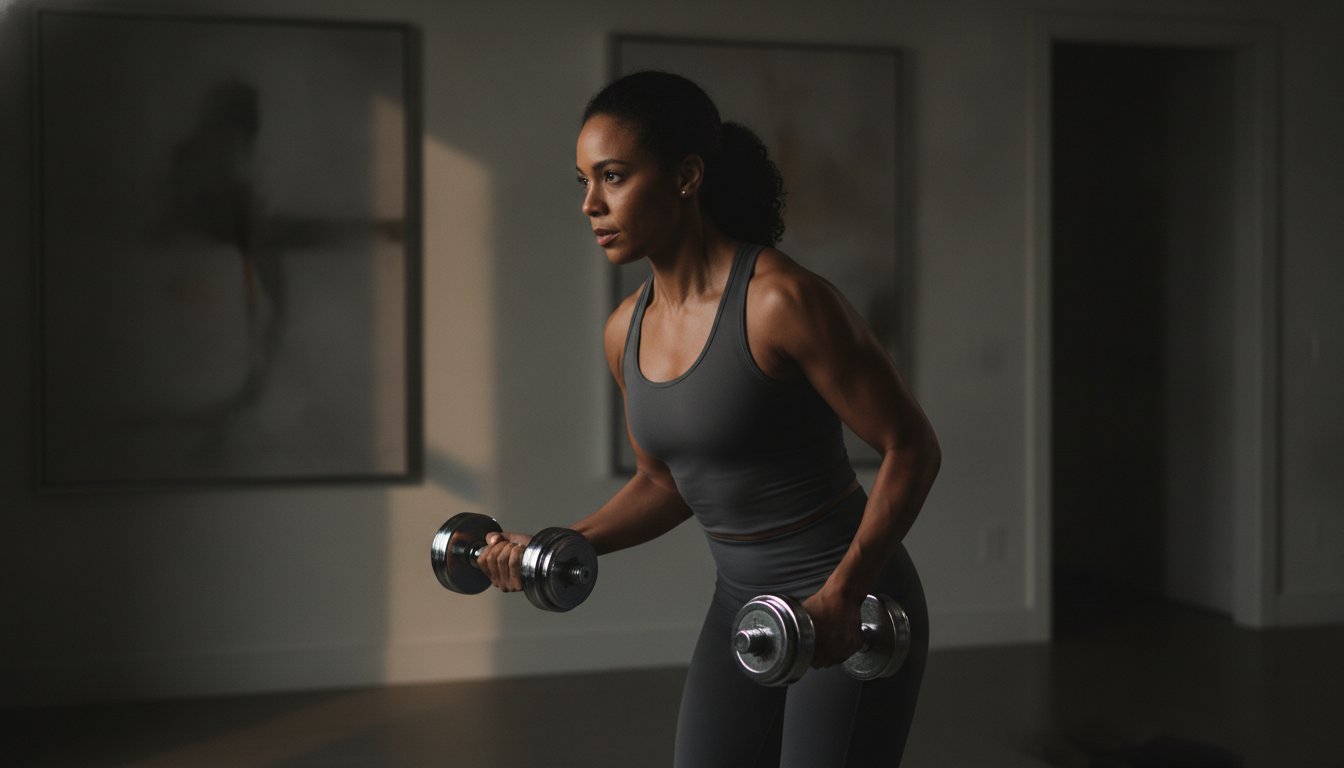
Once your movement patterns are established, external load becomes the next logical evolution. Adjustable dumbbells are the “architect’s choice” for space-saving home gyms. They offer the versatility of an entire rack of weights within a single pair of handles. For women ready to commit to a focused approach, following a dumbbell only workout plan female trainees can execute at home is often a superior alternative to accumulating a variety of equipment. In 2026, many high-quality adjustable sets are available for under $200, making them a wise investment for long-term power. If you prefer a more dynamic approach, suspension trainers like the TRX Home2 System, priced around $232 as of May 2026, offer a compact way to challenge your stability.
Choosing a starting weight requires honesty and precision. You need a load that allows for perfect form while still providing a genuine challenge by the final rep. The transition from bodyweight to external load should feel like a natural progression of your capability. It’s not about lifting the heaviest object in the room; it’s about lifting the right object to signal growth to your body. As your strength increases, your equipment should grow with you, ensuring the “intentional stress” remains consistent and effective.
Many mainstream fitness guides offer a list of movements but no method for making them harder. They leave you trapped in a cycle of maintenance. To architect a stronger body, you must embrace the principle of progressive overload. This is the intentional application of stress that forces your body to adapt and grow. In the context of strength training for women at home, this means looking beyond the bathroom scale. Your progress is measured by the quality of your execution, the density of your sessions, and the precision of your rest periods.
Every repetition has a specific architecture. The eccentric phase, which is the lowering portion of a lift, is where the most significant muscle construction happens. Don’t let gravity do the work. Control the weight on the way down to maximize the stimulus without needing a room full of heavy machinery. This deliberate slowing of the movement builds lasting power and structural integrity.
Hypertrophy doesn’t always require more weight; it requires more focus. In a quiet home setting, you can develop a deep mind-muscle connection that’s often impossible in a crowded gym. By slowing down your tempo, you can create more structural change with a 10-pound weight than a distracted person can with 20 pounds. Time under tension is the primary driver of hypertrophy at home. It forces your body to recruit more muscle fibers and stay engaged throughout the entire range of motion.
When a movement feels easy, it’s a signal to evolve. You can increase the difficulty by adjusting your reps, shortening your rest, or choosing a more complex variation of the same movement. Implementing progressive overload for women ensures your journey is one of continuous development. Keep a training log to visualize your expanding physical capability. Seeing your numbers move from five reps to ten is a far more powerful motivator than any aesthetic metric. To ensure your entire frame is nurtured, a balanced session should include:
If you’re ready to move beyond generic templates and embrace a structured path, the at home strength program for women offered through EVORA Essentials provides the precision-based programming you need to succeed.
The journey toward lasting power is not a straight line; it is a deliberate evolution of your physical capability. Many generic programs leave you wondering what to do once the first month ends. They provide a temporary fix rather than a permanent framework. The EVORA tiered system is designed to eliminate this uncertainty by providing a logical, sequential path for strength training for women at home. It moves you from the initial stages of structural discovery to the heights of sophisticated mastery.
Your journey begins with EVORA Start. This program provides the essential beginner strength training for women, focusing on the architecture of foundational movement. Once you have established this bedrock of stability and form, you can naturally transition to EVORA Essentials and eventually EVORA Elite. These advanced tiers are for those who seek to refine their biological intelligence and push the boundaries of their physical potential. Every level remains committed to science-backed, hormone-smart programming that respects your unique physiology.
Training in a domestic setting requires more than just weights; it requires a roadmap. Having a digital partner removes the burden of decision fatigue. You no longer have to guess which movements to perform or how to adjust your intensity based on your cycle. Every session is designed by Shannon Moore, an empathetic expert who understands the intersection of high-level physiology and everyday life. This clarity allows you to step onto the mat with total confidence. You can focus entirely on the precision of your execution while knowing the underlying science is already accounted for.
Transformation begins the moment you stop “working out” and start training with intent. This shift in perspective turns your home into the primary site of your future physical architecture. You aren’t just moving to burn energy; you’re moving to build a resilient, capable frame that serves you for decades. By aligning your effort with your biological rhythm, you create a sustainable practice that nurtures rather than depletes. It’s time to stop settling for generic templates and start following a plan that was built for you. Join the EVORA community and start your intentional journey today.
You’ve moved beyond the “home workout” trap and discovered that your living room is a sanctuary for genuine biological construction. By aligning your effort with your unique hormonal rhythm and embracing the logic of progressive overload, you’ve established a foundation for lifelong health. True power isn’t a temporary visual outcome. It’s a vital tool for daily life. Strength training for women at home is no longer a compromise but a sophisticated practice of intentional growth and structural integrity.
EVORA was founded by Shannon Moore after her own 110-pound personal transformation to provide the science-backed, hormone-smart programming that mainstream fitness often ignores. Our tiered learning system ensures that whether you’re beginning with foundational movements or seeking elite-level mastery, you always have a logical path forward. You don’t have to navigate this journey alone or rely on generic templates that disregard your physiology. Start your intentional strength journey with EVORA Start today. Your future self is waiting for the resilient framework you begin building now. It’s time to trade the frantic burn for a deliberate, lasting build.
Your musculoskeletal system responds to the quality of the stimulus rather than the location of the equipment. Muscle construction is driven by mechanical tension and metabolic stress; these can be achieved just as effectively with dumbbells and resistance bands as with commercial machines. Training in your own space often allows for a deeper mind-muscle connection and removes the performative pressure that can distract from technical precision.
A frequency of two to four sessions per week is ideal for most individuals. This rhythm provides enough stimulus to signal growth while allowing the necessary 48 to 72 hours for muscle protein synthesis and neurological recovery. Consistency in strength training for women at home is more valuable than sporadic high-intensity efforts that lead to systemic exhaustion.
Lifting weights creates structural density and physical capability rather than unwanted mass. Women generally lack the high levels of testosterone required to build significant bulk by accident. Instead of looking larger, you’ll likely notice an improved posture and a more resilient, capable frame that supports your daily life with ease.
Prioritize versatility and the ability to apply progressive overload. A set of long resistance bands and a pair of adjustable dumbbells are the most effective foundational tools. These minimalist items allow you to perform hundreds of movement variations and gradually increase the intentional stress on your body without requiring a dedicated gym room.
Focus on the “reps in reserve” method to gauge your intensity. You’re using the correct load if you finish a set feeling like you could have performed one or two more repetitions with perfect form. If your technical precision wavers before the set is done, the weight is too heavy; if you finish without feeling a genuine challenge, it’s time to increase the load.
Starting at home is an excellent way to master foundational movement patterns without external judgment. You can begin with bodyweight exercises to build your initial physical architecture and master the mind-muscle connection. This approach ensures you have a safe, solid framework before you transition to using external weights or more complex programming. If you’re looking for a science-backed starting point, an at home strength program for women designed around your unique physiology can provide the structured guidance you need from day one.
Your hormonal fluctuations dictate your energy levels and recovery capacity. During the follicular phase, rising estrogen supports higher intensity and power. In the luteal phase, rising progesterone may increase your body temperature and fatigue, making it a better time for nurturing maintenance and technical focus. Aligning your strength training for women at home with these shifts promotes long-term physiological harmony.
A plateau is simply a signal that your body has adapted to its current stressor. Instead of working harder, work more intentionally by adjusting your training variables. You can break through a plateau by slowing down your tempo, shortening your rest periods, or increasing the total volume of your sets. These small adjustments introduce new stimulus and force your body to continue its process of construction.