

What if the very workouts you’ve relied on for years are now the primary source of your exhaustion? According to a 2024 global meta-analysis, over 64% of women experience significant physical and mental exhaustion during this life stage. You might notice that your usual efforts no longer yield the same results, or that muscle tone is fading despite your consistency. This shift isn’t a failure of will; it’s a change in your biological architecture. Transitioning to intentional strength training for perimenopause allows you to stop fighting against your changing hormones and start providing the structural support your body now requires.
In this guide, you’ll discover how to move away from high-stress, punishing routines and toward a sustainable method that protects your muscle mass, metabolism, and bone density. We’ll bridge the gap between clinical research and your daily life, offering a logical path to maintaining your healthspan. You’ll learn the specific lifting protocols recommended by current experts and how to integrate recovery as a foundational pillar of your progress. From understanding the impact of declining estrogen to implementing a clear, science-backed plan, we’re laying the groundwork for a future of empowered movement and lasting strength. This journey is often most successful when paired with professional clinical guidance, such as the holistic medicine and wellness expertise of Dr. Tiffany Yeo-Reddy.
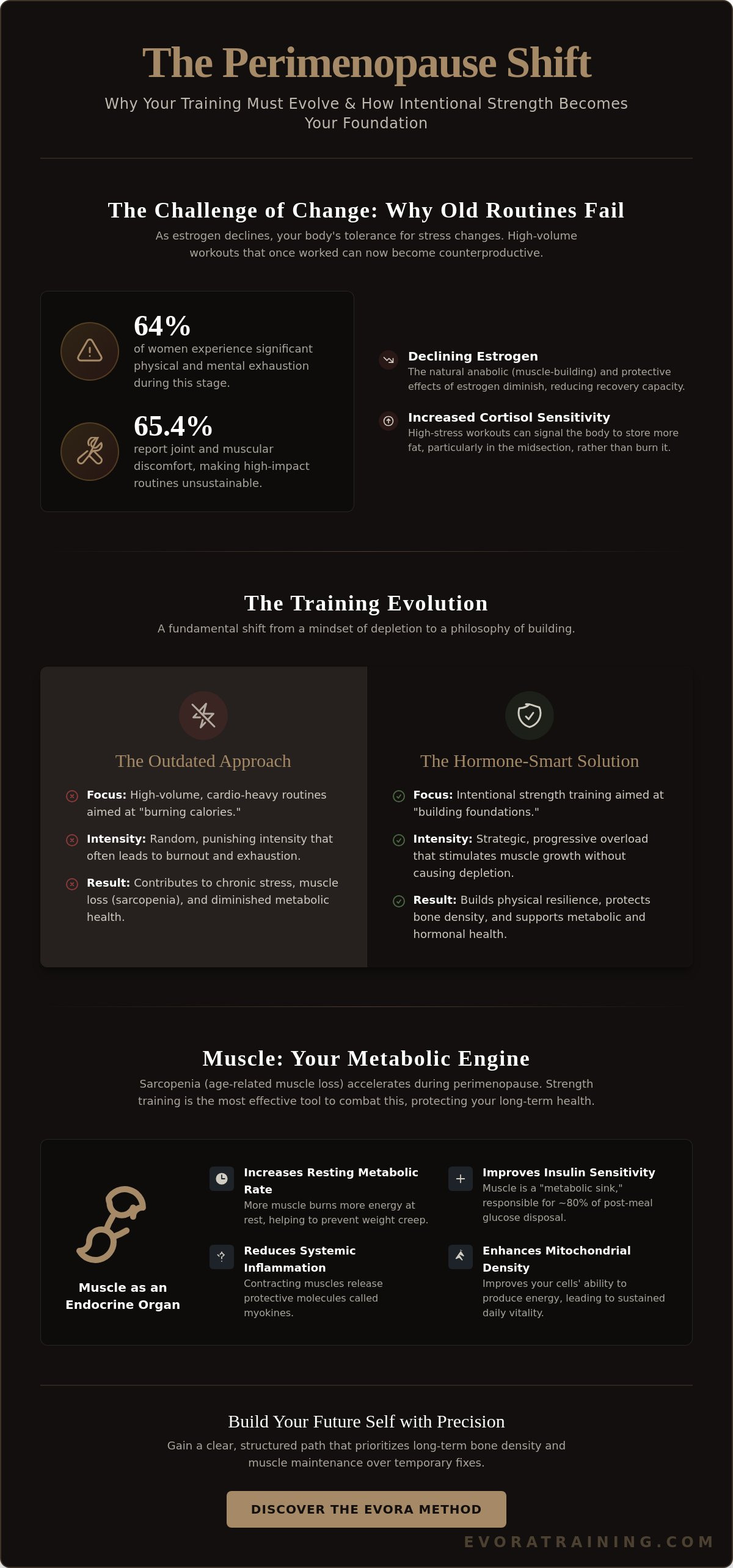
Perimenopause is often described as a “second puberty.” It is a profound biological recalibration that requires a fundamental shift in how you move and how you view your physical capability. For years, the fitness industry has sold a high-pressure narrative of “more is better,” pushing high-volume cardio and aggressive calorie depletion. During the perimenopause transition, these methods don’t just stop working; they often become counterproductive. As estrogen begins its erratic decline, your body’s tolerance for stress changes. What once felt like a healthy challenge now feels like a source of chronic depletion. We are moving away from the era of physical punishment and toward a future of biological intelligence.
Your body is becoming more sensitive to cortisol, the primary stress hormone. When you double down on high-intensity intervals or exhausting runs to combat midsection weight gain, you may unintentionally signal your body to store more fat. A 2024 global meta-analysis found that 65.43% of women experience joint and muscular discomfort during this time, making traditional high-impact routines physically unsustainable. Estrogen is naturally protective and anabolic; it helps you build and maintain muscle mass. As it fluctuates, your capacity to recover from high-stress workouts diminishes significantly. Traditional cardio-heavy approaches ignore this shift. They focus on the scale while ignoring the preservation of your metabolic engine. You aren’t losing your discipline. You are simply using an outdated map for a new physiological landscape. The shift from aesthetic-driven goals to physiological-driven needs is a hallmark of this transition.
Strength training for perimenopause isn’t about chasing a high heart rate or achieving a state of collapse. It is about providing a mechanical signal to your bones and tissues that says, “Stay strong.” It acts as a necessary architectural support for a system that no longer has a steady supply of estrogen to do the heavy lifting. We must move away from the mindset of burning calories and toward a philosophy of building foundations. Instead of viewing your body as an enemy to be conquered with intensity, we view it as a complex system to be nurtured through precision and load. In the evolving health landscape of 2026, intentional strength training for perimenopause is recognized as a vital metabolic necessity for maintaining long-term vitality. This approach rejects the frantic pace of mainstream fitness and opts for a steady, deliberate rhythm that ensures longevity and resilience.
Sarcopenia is not just a clinical term for aging; it is the gradual erosion of your metabolic engine. Starting as early as age 35, the body begins to lose muscle mass at a rate of roughly 3 to 8 percent per decade. In perimenopause, this process accelerates as the protective influence of estrogen wanes. Estrogen is naturally anabolic, meaning it supports the growth and repair of tissues. This is why strength training for perimenopause is a foundational requirement for health rather than an optional hobby. When you lose muscle, you don’t just lose strength; you lose the primary site of your body’s energy production and regulation.
Muscle functions as a critical metabolic sink. It is responsible for approximately 80 percent of post-meal glucose disposal. When muscle mass decreases, blood sugar has fewer places to go. This often leads to the insulin resistance and midsection weight gain that many women find frustrating during this transition. By adopting intentional strength training for perimenopause, you are not just lifting weights; you are maintaining the health of your mitochondria, the powerhouses within your cells that dictate your energy levels and recovery capacity. Muscle provides the following metabolic benefits:
Muscles are more than just pulleys for movement. They are active endocrine organs. When you contract muscle against resistance, you release myokines. These signaling molecules communicate with the brain to improve cognitive health and help manage systemic inflammation. This is the core of strength training for hormonal balance. By building muscle, you also help regulate ghrelin and leptin, the hormones that govern hunger and satiety. This biological communication ensures your system remains in a state of construction rather than depletion. Women managing other hormonal conditions, such as those exploring strength training for PCOS, will recognize this same principle of using intentional resistance work to restore hormonal architecture from the inside out.
While walking is excellent for cardiovascular health, it provides insufficient stimulus for bone remodeling. Your skeleton requires axial loading, which is the application of force through the long axis of the bones. Research indicates that bone density loss can reach up to 20 percent during the menopause transition without specific intervention. We must prioritize resistance to trigger the mechanical signals necessary for bone maintenance. When structuring your workout routine, focus on movements that challenge the skeletal system safely and effectively. Building this architectural support is the focus of our philosophy at EVORA.
“I’m just too tired.” This is the most frequent objection raised when discussing strength training for perimenopause. It’s a completely valid response to a fitness culture that equates progress with total exhaustion. Mainstream messaging suggests that if you aren’t gasping for air or soaked in sweat, you aren’t working hard enough. This is a fundamental misunderstanding of biological stimulus. Intensity is a measure of heart rate and perceived exertion; intentionality is a measure of precision, form, and load. We don’t need more intensity. We need more intention.
In your 20s, your body could likely tolerate “junk volume”—those extra sets and exercises that added fatigue without much benefit. Now, your recovery window has shifted. A 2026 global study with over 17,000 women found that 83% experience physical and mental exhaustion during perimenopause. Adding more volume to an already depleted system doesn’t build muscle. It simply deepens the deficit. We must prioritize high-quality sets that provide the necessary signal for growth without overwhelming your capacity to repair and recover.
High-intensity interval training (HIIT) is often marketed as the ultimate solution for weight loss. For a woman in perimenopause, however, chronic HIIT can become a cortisol trap. Excessive high-heart-rate work signals the body to remain in a state of high stress. This can exacerbate sleep issues and promote fat storage around the midsection, the very thing many are trying to avoid. Intentional lifting provides the necessary mechanical stimulus to the muscles without the same level of systemic stress. Instead of watching a stopwatch, we learn to listen to biofeedback. If your sleep quality drops or your irritability peaks, your body is asking for more recovery, not more intensity. Understanding how your hormonal cycle influences your training capacity is equally important; applying luteal phase workout ideas that honor your body’s shifting biology can help you sustain strength without deepening the cortisol burden.
Efficiency is the cornerstone of a sustainable routine. For a busy woman, focusing on compound movements like squats, deadlifts, and presses yields the greatest return on investment. These lifts engage multiple muscle groups and stimulate the central nervous system more effectively than isolation exercises like bicep curls. By mastering these foundational patterns, you build a framework of strength that supports your daily life. If you’re new to these movements, our beginner strength training women guide provides the necessary form basics to start safely. We focus on the quality of every repetition to ensure every minute spent training contributes to your long-term vitality.
Efficiency is often confused with speed. In the context of strength training for perimenopause, efficiency means doing exactly what is required to trigger a biological response and nothing more. While mainstream fitness often pushes five-day “body part splits,” this high-frequency volume often leads to systemic inflammation rather than muscle growth. Two or three full-body sessions per week provide a superior stimulus. This frequency allows for the 48 to 72 hours of recovery your tissues now require to repair and strengthen. It’s a shift from a schedule of depletion to a rhythm of construction.
Rest between sets is another area where intentionality must replace random intensity. Resting for 90 to 120 seconds is a metabolic requirement for clearing byproducts and regenerating the energy needed for high-quality force production. If you’re rushing from one exercise to the next to keep your heart rate high, you aren’t training for strength; you’re training for exhaustion. This deliberate pace ensures that every repetition is performed with precision, protecting your joints while maximizing the stimulus to the muscle. This approach is especially vital on days when you experience symptom flares or low energy. You don’t need to skip the session; you simply need to adjust the load and respect the rest.
To see lasting change, you must eventually challenge your muscles with more resistance. This process, known as progressive overload, should be incremental and safe. We prioritize the logbook over the scale as our primary tool for measurement. Tracking your lifts allows you to see the architectural progress you’re making, even when your weight remains stable. For a structured way to monitor these gains, our female body transformation program provides a hormone-smart framework for long-term tracking and progress.
Muscle isn’t built during the workout; it’s built during the rest that follows. As you age, a phenomenon called anabolic resistance makes the body less efficient at utilizing protein for muscle repair. This means your recovery protocols must be as disciplined as your training. Prioritize high-quality sleep as your ultimate performance enhancer. On non-lifting days, choose active recovery like gentle walking or mobility work to support joint health without adding to your systemic stress load. If you’re ready to move away from exhausting templates, discover how EVORA Start can help you build a sustainable foundation.
Mainstream fitness is often a cycle of guesswork and frustration. We reject the one-size-fits-all template in favor of a methodology grounded in biological intelligence. The EVORA philosophy is built on the understanding that your body is a complex system requiring architectural support, not a problem to be solved through depletion. By prioritizing strength training for perimenopause through a structured, tiered approach, we remove the decision fatigue that often leads to inconsistent progress. You no longer have to wonder if a workout is “too much” or “not enough.” Our digital-only delivery provides the focus and privacy you require, allowing you to train with precision in a space that feels safe and effective. This is not about chasing a temporary aesthetic; it is about constructing a lasting framework for your health.
We provide a logical progression that respects your physiological readiness. Each stage is designed to build upon the last, ensuring your framework is solid before increasing the load. This prevents the injury and burnout often associated with generic high-intensity programs.
As we move through 2026, the evidence is undeniable. The path to hormonal vitality is through construction, not destruction. You don’t need another high-pressure workout that leaves you exhausted and inflamed. You need a plan that understands your unique landscape. The goal is not just to navigate the transition but to enter menopause feeling strong, capable, and confident. By choosing intentional strength training for perimenopause, you are investing in your future self. You are building a body that can support your life with ease and resilience. It is time to stop punishing your system and start providing the nurturing it deserves. Experience the EVORA difference with our training modules.
The perimenopause transition is not a decline to be feared; it is a profound physiological shift to be managed with biological intelligence. By prioritizing strength training for perimenopause, you move away from the cycle of chronic exhaustion and toward a framework of lasting resilience. You’ve seen how muscle acts as your most valuable metabolic asset and why intentional load always outperforms random intensity. This is a journey of construction rather than destruction, replacing industry noise with scientific clarity and a meditative focus on progress.
Founded by Shannon Moore following her own 110lb transformation, EVORA is built on the belief that fitness should nurture the body rather than deplete it. Our science-backed modules are specifically tailored to female physiology, focusing on sustainable, long-term health over superficial quick fixes. We provide the architectural map you need to navigate this life stage with confidence and precision. This is your opportunity to stop fighting your body and start providing the structural support it requires for the decades ahead.
Build your foundation with the EVORA Start program today. Your future self is waiting to be built with care, authority, and unwavering strength.
It is never too late to begin a resistance practice. Your body retains the ability to adapt and build muscle regardless of your current life stage. Starting strength training for perimenopause now provides the structural support your system requires to navigate the coming years with resilience. Even a late start can significantly reduce the risk of osteopenia and sarcopenia, ensuring you enter the next phase of life with a solid physical foundation.
Lifting heavy weights will not result in a bulky appearance. Women naturally have lower levels of testosterone, and the hormonal shifts of perimenopause further prioritize muscle maintenance over excessive hypertrophy. Instead of bulk, you’ll develop improved muscle tone and a more efficient metabolic engine. This approach focuses on building a compact, functional framework that supports your daily life rather than creating an oversized aesthetic.
We recommend two to three full-body sessions per week for optimal results. This frequency allows for the 48 to 72 hours of recovery your tissues need to repair and strengthen. While mainstream fitness often pushes for daily intensity, a more deliberate rhythm prevents systemic exhaustion. Quality and consistency in these few sessions will outperform a high-volume schedule that leads to burnout or chronic inflammation.
Prioritize strength training if your goal is metabolic health and weight management. Building muscle mass provides a long-term solution by increasing your resting metabolic rate and improving insulin sensitivity. While steady-state cardio has its place for heart health, strength training for perimenopause addresses the underlying physiological changes that lead to midsection weight gain. Think of strength as building the engine and cardio as the occasional tune-up.
You can absolutely engage in resistance training with joint pain, provided you prioritize form and appropriate load. In fact, strengthening the muscles surrounding your joints often provides the architectural support needed to reduce discomfort. We focus on controlled, intentional movements that build stability without overstressing the connective tissues. It is about choosing exercises that respect your current range of motion while gradually building your capability.
You are lifting heavy enough when the final two repetitions of a set feel challenging while you still maintain perfect form. This is often measured using the Rate of Perceived Exertion (RPE). If you could easily perform ten more repetitions at the end of a set, the load is likely too light to trigger a biological change. We look for a load that demands focus and effort without causing a breakdown in your structural integrity.
You can achieve measurable progress either at home or in a gym setting. The body recognizes resistance, not the environment. While a gym offers a wider variety of equipment for progressive load, many women successfully build their foundation using dumbbells or resistance bands at home. What matters most is the intentionality of the movement and a structured plan that allows you to gradually increase the challenge to your muscles.
Changes in body composition typically become visible within eight to twelve weeks of consistent, intentional training. While neurological improvements and energy shifts often happen sooner, building muscle and shifting metabolic health is a steady, architectural process. It requires patience and a rejection of the “quick fix” mentality. Focus on the measurable progress in your logbook, and the physical outcomes will naturally follow as your body adapts to its new stimulus.