

The heaviest lift you’ll perform this month isn’t on the barbell. It’s the quiet decision to honor your internal architecture when your biology shifts. You’ve likely experienced those days where the gym feels suffocating and your usual weights feel like lead. This isn’t a failure of discipline or a loss of fitness. It’s a physiological signal. By integrating specific luteal phase workout ideas into your routine, you can stop fighting your body and start working with your natural rhythm to maintain your hard-earned strength.
We understand the frustration of feeling underserved by traditional fitness templates that demand constant, linear intensity. It’s exhausting to push through unexplained fatigue only to end up feeling depleted rather than empowered. This article provides a science-backed path to sustain your progress without the burnout. You’ll learn how to adjust your training volume, manage your rising core temperature, and shift your focus from physical punishment to intentional maintenance. We’re moving away from the loud, aggressive industry tropes toward a more sophisticated and grounded approach to your long-term physical development.
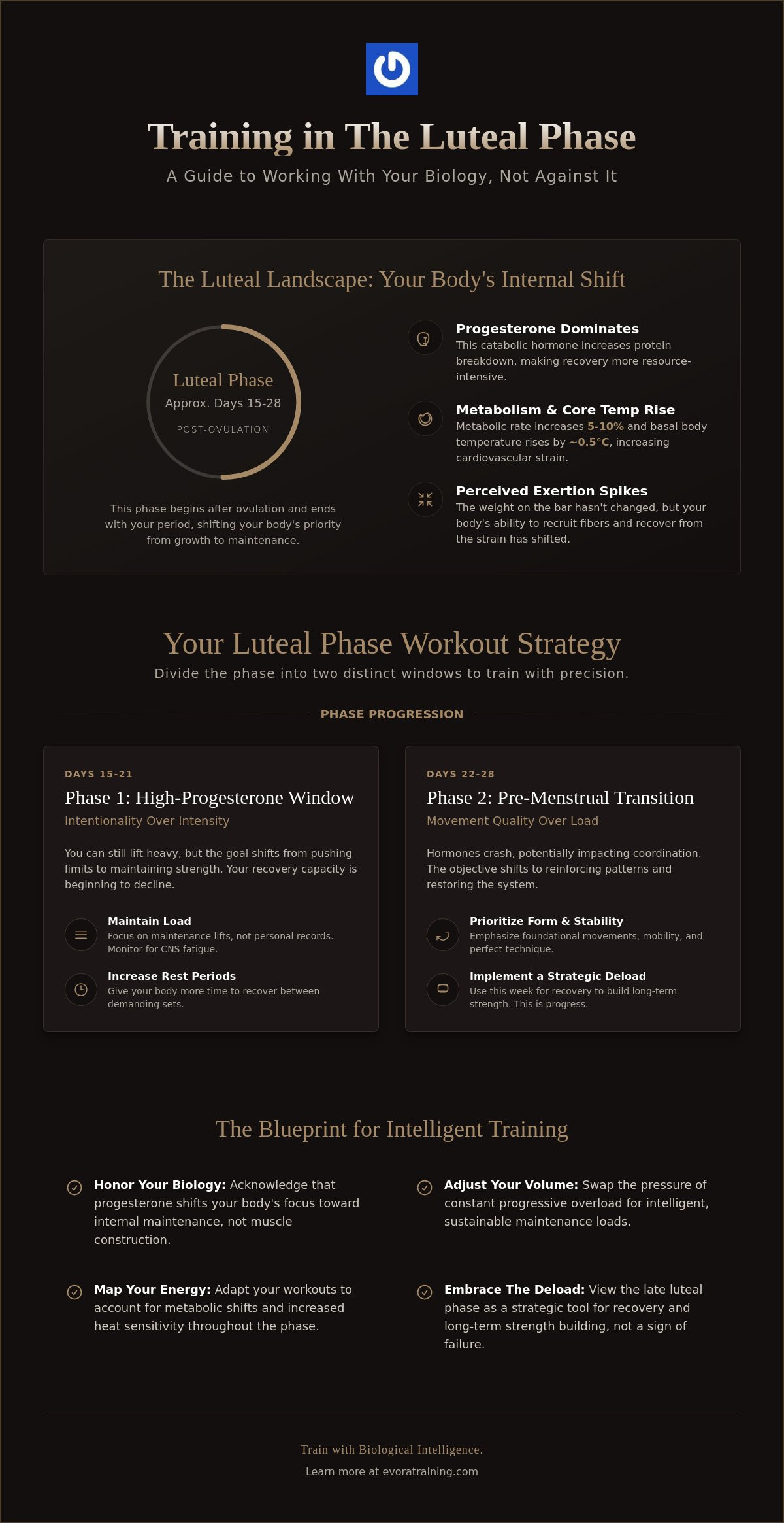
The Luteal phase begins immediately after ovulation and persists until the first day of your period. During this window, progesterone becomes the dominant architect of your internal environment. It shifts the body toward a “pro-gestation” state, prioritizing the maintenance of the uterine lining over the aggressive construction of new muscle tissue. This isn’t a flaw in your design; it’s a precise biological recalibration. The luteal phase is a period where the body’s metabolic rate increases by 5-10%. This metabolic surge means your system is working harder even at rest, fundamentally changing how you should approach your training volume.
In the first half of your cycle, estrogen acts as the primary “builder,” facilitating muscle growth and insulin sensitivity. As you enter the luteal phase, estrogen levels drop and progesterone rises. Progesterone is a catabolic hormone. It increases the rate of protein breakdown, which makes the recovery process more resource-intensive than it was just a week prior. This hormonal pivot is why your perceived exertion spikes. The weight on the bar hasn’t changed, but your body’s ability to recruit fibers and recover from the strain has shifted. When looking for luteal phase workout ideas, it’s essential to acknowledge that your baseline for “hard work” has moved. Pushing through this phase with the same intensity as your follicular phase strength training often leads to burnout rather than progress. To better understand how your biology affects your performance, you can explore Telehealth Hormone and Wellness Programs for personalized support.
Your physiology undergoes a subtle but impactful thermal shift during this time. A 0.5-degree rise in basal body temperature might seem negligible, but it significantly alters your aerobic threshold. This elevation increases the cardiovascular strain of every movement, causing your heart rate to sit higher at rest and during exercise. You might find yourself feeling “out of breath” during sets that normally feel routine. This isn’t a loss of cardiovascular fitness. It’s a response to a more demanding internal climate. Prioritizing strength training for hormonal balance allows you to adjust your intensity to match this metabolic reality. Instead of forcing your body to perform under suffocating conditions, you can implement luteal phase workout ideas that nurture your system while maintaining your foundational strength. Working with your body’s current temperature regulation is a sign of biological intelligence, not a lack of discipline.
Mainstream fitness advice often treats the fourteen days before your period as a single, monochromatic block of “low energy.” This oversimplification fails to account for the nuanced physiological shifts occurring within the phase itself. Your internal landscape on day 16 is vastly different from day 26. Successfully cycle syncing your workouts requires a more granular understanding of these shifts. By mapping your energy architecture, you can move away from rigid, one-size-fits-all templates that often lead to injury or frustration.
Directly following ovulation, progesterone begins its ascent. This is the “high-progesterone window” where you may still feel capable of moving significant weight. However, your recovery capacity begins to decelerate. During this time, the body increases amino acid oxidation, meaning your system is literally breaking down protein at a higher rate. This makes the implementation of specific luteal phase workout ideas focused on maintenance rather than growth essential. You can still lift heavy, but you must increase rest periods between sets. Monitor your Central Nervous System (CNS) for signs of early fatigue, such as a loss of “pop” in your movements or a lingering sense of heaviness after a session. This is the time for intentionality, not intensity.
As you approach the end of your cycle, both estrogen and progesterone crash. This hormonal withdrawal often triggers a drop in coordination and a rise in “brain fog,” which can compromise your lifting form. Your objective shifts from maintaining load to prioritizing movement quality. This is an ideal time for at home dumbbell workouts for women that emphasize mobility and foundational stability. These sessions serve as a restorative bridge, keeping you active without overtaxing a system that is currently focused on internal shedding. Using this week as a strategic deload allows for a more powerful return to intensity once your period begins.
Understanding these distinct windows ensures that your training supports your long-term health. If you’re looking for a structured way to apply these principles, our EVORA Start program is designed to guide you through these biological shifts with professional precision. You don’t have to guess how to adjust your training; you just have to follow the architecture of your own body.
Many mainstream fitness resources suggest abandoning the weight room entirely the moment your hormones shift. They offer a binary choice: push through the exhaustion or retreat to light stretching. We reject this all-or-nothing approach. You don’t need to stop lifting to protect your hormonal health; you simply need to shift your focus from progressive overload to a maintenance load. This transition isn’t a retreat. It’s a strategic pause that allows your internal architecture to recover while keeping your neurological adaptations sharp. Effective luteal phase workout ideas prioritize the preservation of your hard-earned strength rather than the pursuit of a new personal best.
There is a persistent myth that a week of reduced intensity leads to muscle loss. In reality, research on menstrual cycle and muscle strength indicates that while your peak power may fluctuate, your foundational capacity remains remarkably stable. Strategically deloading during this phase prevents the cortisol spikes that lead to hormonal belly or stubborn fat. By lowering the tax on your central nervous system, you’re actually setting the stage for more significant gains in the following weeks. It’s a process of nurturing your system so it can continue to build on a solid, rested foundation. To maximize those gains when your energy returns, pairing this approach with intentional follicular phase strength training creates a complete, cycle-aware framework for lasting progress.
A successful deload involves reducing your total volume by 30-50%. This means if you usually perform four sets of an exercise, you might drop to two or three. Keep the weight challenging enough to feel the resistance, but always stop several reps short of failure. This isn’t about “taking it easy” in a way that feels unproductive. Instead, you’re using this time to refine your mind-muscle connection. Focus on the tempo of each movement and the precision of your form. These subtle adjustments keep your muscles engaged and your movement patterns ingrained without the heavy systemic tax that leads to depletion.
Single-limb work is an exceptional tool for maintaining intensity when your cardiovascular system feels strained. Exercises like Bulgarian split squats or single-arm rows allow you to work each side of the body with focused precision. Because you’re moving less total mass at one time, the demand on your heart and lungs is significantly lower than a heavy bilateral squat or deadlift. This approach allows you to keep the local muscle intensity high while respecting your body’s current thermal and metabolic limits. Unilateral training also improves the architecture of your core stability, ensuring that your foundational framework remains resilient even when your energy levels are in transition.
Selecting the right luteal phase workout ideas involves more than just slowing down. It requires a deliberate selection of movements that sustain muscle endurance without triggering a systemic stress response. Many women are told to stick to light stretching when their hormones shift, but this ignores the desire to maintain a solid strength foundation. Strength-focused yoga, for instance, isn’t merely about flexibility. It’s about holding isometric poses that challenge muscle fibers and bone density while keeping the heart rate steady. Similarly, a “nurturing” walk in Zone 2 is far superior to high-intensity intervals during this phase. It encourages blood flow and lymphatic drainage without the cortisol spike associated with anaerobic work. These movements address lower back pain and bloating by gently engaging the core and pelvic floor, providing relief through movement rather than just rest.
This session is designed to keep you connected to your power without overtaxing your system. Begin with ten minutes of dynamic mobility focusing on hip and pelvic floor health to prepare the body’s foundational architecture. For your main lift, perform three sets of five to eight reps of a compound movement, such as a squat or deadlift, at roughly 70% of your maximum effort. This load is enough to maintain neurological adaptations without causing exhaustion. Follow this with accessory work consisting of three sets of ten to twelve reps of unilateral movements like lunges or dumbbell presses. These single-limb exercises allow for high local intensity with lower cardiovascular strain. Conclude with five minutes of focused diaphragmatic breathing. This isn’t just a “cool down”; it’s a physiological tool to lower cortisol and transition your body back into a restorative state.
When the luteal heat spike makes the gym feel suffocating, swimming or water aerobics offer a rational alternative. The hydrostatic pressure of the water aids in circulation while the temperature helps manage your elevated basal body heat. This allows you to stay active without feeling like you’re overheating. Pilates-inspired core work is another excellent choice to maintain “foundational strength” and pelvic stability. By incorporating active recovery ideas for women, you can ensure that your “off” days are still contributing to your long-term progress. These activities focus on the construction of a resilient body that doesn’t rely on constant intensity to see results. If you’re ready to stop the cycle of exhaustion and start training with biological intelligence, explore how EVORA Start can provide the structure your unique physiology requires.
The gym should never be a place of physical punishment. It is a site of deliberate construction. Traditional methods often ignore the nuances of the female cycle, leading to a frustrating loop of burnout and perceived failure. We replace these random acts of fitness with a hormone-smart architecture. EVORA Start integrates cycle-aware training into a structured program that respects your internal rhythm. By tracking your internal data, such as basal temperature shifts, sleep quality, and perceived exertion, alongside your lifting stats, you gain a complete picture of your physiological state. This is the difference between guessing your way through a workout and training with biological intelligence. When you utilize specific luteal phase workout ideas, you’re not just moving; you’re maintaining the integrity of your system.
EVORA Elite takes this precision further by prioritizing longevity over short-term aesthetic “shredding.” We aren’t interested in temporary fixes that deplete your resources or compromise your hormonal health. Instead, we build frameworks that last for decades. This approach ensures that your strength is a tool for daily life, not just a visual outcome for a single season. It’s a shift from the loud, aggressive messaging of the fitness industry to a calm, rational path forward.
The luteal phase is frequently viewed as a setback in a linear training plan. We re-frame it as a critical period to build the foundation for your next cycle’s peak performance. Listening to your body’s signals isn’t a sign of weakness. It’s the cornerstone of a female body transformation program that actually lasts. This empathetic method is rooted in Shannon Moore’s own 110-pound journey. Her transformation proved that measurable progress doesn’t require physical punishment or high-pressure messaging. It requires a partnership with your physiology. When you implement luteal phase workout ideas with intentionality, you protect your metabolic health while sustaining your hard-earned strength.
Choosing the right path depends on your current experience level and hormonal needs. We offer three distinct tiers to support your development:
You don’t have to navigate these hormonal shifts alone. You can join a science-backed community that truly understands the complexities of female physiology. Explore the EVORA training modules and start your intentional journey today.
Your cycle is a sophisticated roadmap for progress rather than an obstacle to be overcome. By integrating intentional luteal phase workout ideas, you move from fighting your biology to partnering with it. We’ve explored how progesterone shifts your metabolic needs and why a strategic maintenance load protects your central nervous system. These adjustments aren’t concessions; they are the blueprint for a resilient, long-term strength foundation. You deserve a training methodology that views your body as a complex system to be understood rather than an enemy to be conquered.
We reject the high-pressure industry tropes that prioritize temporary aesthetics over lasting hormonal health. Our science-backed programs are tailored to the unique nuances of female physiology, mirroring the empathetic method developed by Shannon Moore during her own 110lb transformation journey. It’s time to shift your focus from physical punishment to measurable, sustainable progress. Begin your hormone-smart strength journey with EVORA Start and discover the power of intentional strength. Your future self will thank you for the foundation you build today.
Yes, lifting heavy is acceptable during the early luteal phase when progesterone is rising but hasn’t yet peaked. However, your recovery capacity is lower during this window. Instead of chasing new personal records, focus on maintaining your existing load with increased rest periods. This approach preserves your neurological adaptations without overtaxing your system. As you move into the late luteal phase, lowering the intensity is a more rational choice for long-term progress.
This sensation of weakness is a biological response to the drop in estrogen and the peak of progesterone. Progesterone increases muscle protein breakdown and raises your basal body temperature, which elevates your heart rate and perceived exertion. Your body is prioritizing internal maintenance over external performance. It isn’t a loss of fitness; it’s a shift in energy allocation. Accepting this temporary change allows you to train with biological intelligence rather than frustration.
Yes, intentional movement can significantly alleviate PMS symptoms. Gentle luteal phase workout ideas, such as mobility flows or Zone 2 walking, encourage lymphatic drainage and improve circulation to the pelvic region. This reduces the severity of bloating and cramps by managing inflammation. These sessions should feel nurturing rather than depleting. Focusing on diaphragmatic breathing during your workouts also helps regulate cortisol, which can stabilize mood swings and lower back tension.
Steady-state cardio is superior to HIIT during the luteal phase. High-intensity intervals trigger a significant cortisol response that your body struggles to clear when progesterone is dominant. This can lead to systemic inflammation and stalled progress. In contrast, Zone 2 cardio maintains your aerobic base without the heavy central nervous system tax. It supports your heart health while respecting your body’s increased core temperature and reduced recovery resources.
Your metabolic rate increases by 5% to 10% during this phase, which often requires an additional 100 to 300 calories per day. Focus on increasing your intake of complex carbohydrates and protein to support the higher rate of amino acid oxidation. This extra fuel prevents the “suffocating” fatigue often felt during workouts. It’s a precise adjustment to match your body’s increased energy expenditure during its internal reconstruction process. For tailored advice on managing these nutritional demands, a fertility nutritionist london can help you design a plan that supports both your fitness goals and your hormonal health.
Ignoring your body’s signals often leads to chronic exhaustion and a plateau in strength. Pushing through significant fatigue triggers excessive cortisol production, which can lead to sleep disturbances and stubborn fat retention. It also increases the risk of injury due to the drop in coordination and joint stability typical of the late luteal phase. Choosing intentionality over intensity protects your long-term hormonal health and ensures you return stronger in the next cycle.
Traditional cycle syncing is less relevant because hormonal birth control suppresses the natural fluctuations of ovulation. You don’t experience the same progesterone peak as those with a natural cycle. However, many women still notice rhythmic changes in energy and mood. Listening to your body remains essential. You can still benefit from adjusting your training volume based on your subjective data, such as sleep quality and perceived exertion, to maintain a sustainable routine.
Key indicators include a resting heart rate that stays elevated and a lack of “pop” in your movements. If you experience lingering muscle soreness for more than 48 hours or find your sleep quality declining, you’re likely overtaxing your system. These are signs that your current training volume exceeds your recovery capacity. Shifting to low-impact luteal phase workout ideas can help you stay active while allowing your internal architecture the space it needs to recover.