



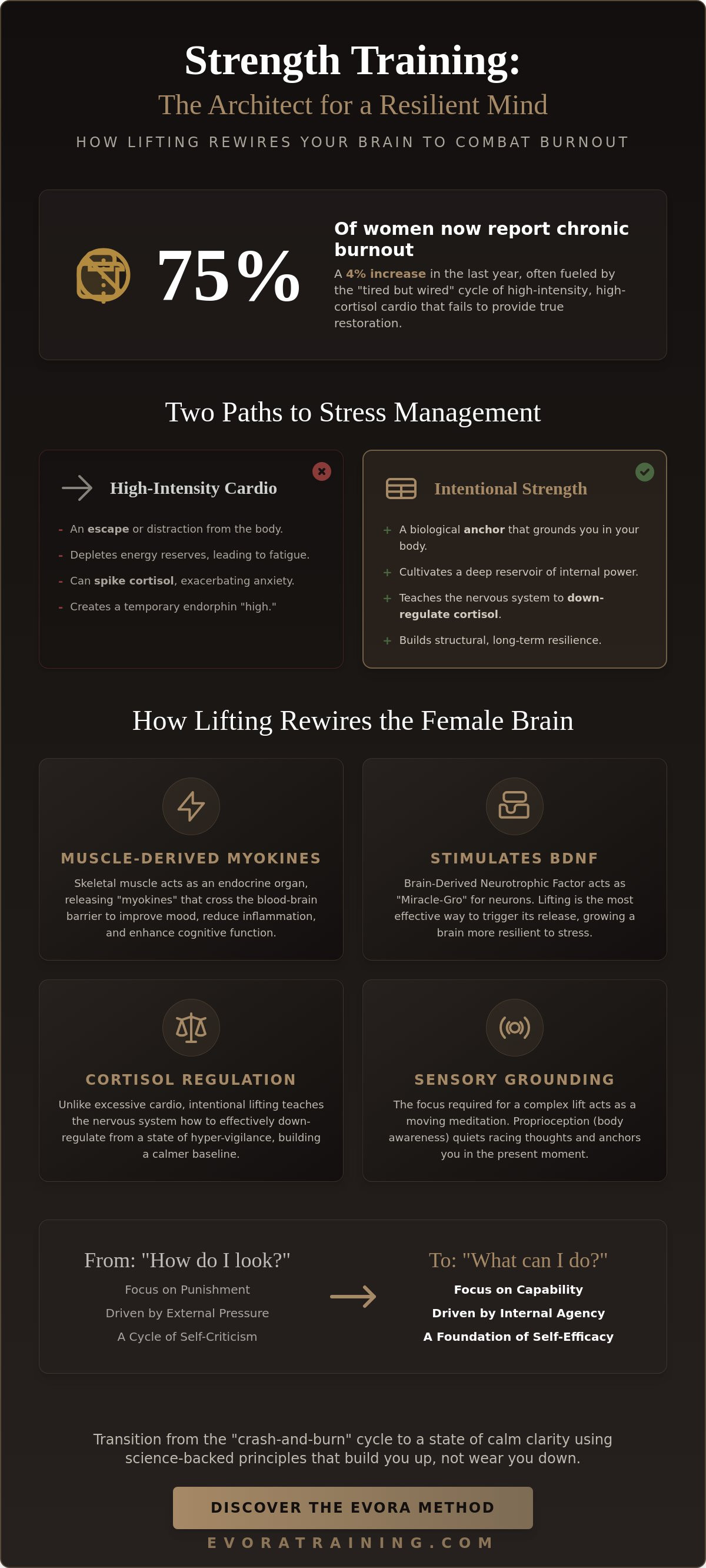
Did you know that 75% of women now report experiencing chronic burnout, a number that actually increased by 4% over the last year? While many of us have been told to run off the stress on a treadmill, that high-intensity cardio often leaves us feeling “tired but wired” rather than restored. It’s time to stop punishing your body and start working with your physiology. Integrating strength training for mental health women isn’t about aesthetics. It’s about building a biological architect for a resilient mind.
You likely feel the weight of constant cognitive load and the frustration of a nervous system that won’t switch off. We agree that the fitness industry has often failed you by offering high-pressure cycles instead of sustainable support. You deserve a path that builds you up rather than one that wears you down. This article reveals how intentional, hormone-smart lifting transforms your brain chemistry to reduce anxiety and build lasting emotional resilience. We will explore the specific neurochemical shifts that occur when you pick up a weight and show you how to create a practice that nurtures your mental clarity and long-term strength.
While many women turn to cardiovascular exercise for stress relief, there is a fundamental difference between the temporary endorphin spike of a run and the structural resilience built through what is strength training. Cardio often serves as an escape or a distraction. It can be a way to run away from the noise in your head. Strength training, however, acts as a biological anchor. It doesn’t ask you to leave your body; it requires you to inhabit it fully. This distinction is vital for women who feel “tired but wired.” Instead of depleting your energy reserves, intentional lifting helps you cultivate a steady, reliable reservoir of internal power.
Skeletal muscle is far more than just a tissue for movement. It functions as a sophisticated endocrine organ. When you engage in consistent strength training for mental health women, your muscles release “myokines.” These specialized messenger molecules cross the blood-brain barrier to improve mood, reduce inflammation, and enhance cognitive function. This creates a direct physiological dialogue between your physical body and your mental state. You aren’t just lifting weights; you are signaling to your brain that you are capable, stable, and strong.
Traditional fitness often pushes a “crash-and-burn” cycle. It encourages you to punish your body with high-intensity pressure to see results. We reject this approach. Intentional strength is about building a foundation, not searching for a temporary high. Every repetition is a controlled, predictable action in an often unpredictable world. This provides a sense of agency that mindless cardio often lacks. You aren’t just moving; you are building a version of yourself that can handle the weight of life with more ease.
Physical capability translates directly into psychological resilience. When you realize you can move a weight that once felt impossible, your brain begins to rewrite its own limitations. This shift moves the focus from “how do I look?” to “what can I do?” It’s a profound transformation of the self-image. Self-efficacy is the primary driver of fitness-related mental health. By focusing on tangible progress, you develop a quiet confidence that carries over into your professional and personal life.
Proprioception, or your body’s ability to sense its position in space, is a powerful tool for reducing anxiety. The focus required for a squat or an overhead press acts as a moving meditation. You can’t ruminate on your to-do list when you’re focused on the tension in your core and the rhythm of your breath. Unlike the repetitive, often mindless nature of a treadmill, mindful lifting forces you to stay present. It grounds your nervous system, quieting racing thoughts through deliberate, intentional movement.
The female brain is not a static organ; it is a dynamic system that responds to the physical demands we place upon it. When we discuss strength training for mental health women, we are looking at a profound neurobiological intervention. It is a way to literally restructure the neural pathways that govern how we process stress and maintain emotional stability. By engaging in resistance, you’re not just building muscle; you’re building a more resilient mind.
Brain-Derived Neurotrophic Factor, or BDNF, acts as a biological fertilizer for your nervous system. This protein supports the survival of existing neurons and encourages the growth of new ones, which is essential for maintaining a stable mood and sharp memory. Scientific data suggests that progressive overload is the most effective way to trigger significant BDNF release. Each time you incrementally increase the challenge to your muscles, you are sending a structural signal to your brain to adapt and grow. In this sense, lifting is precision programming for your hippocampus, the region of the brain most susceptible to the damaging effects of chronic stress.
With 75% of women reporting burnout in 2026, the need for effective stress management has never been higher. Chronic stress often leaves women in a persistent state of hyper-vigilance. While excessive high-intensity cardio can spike cortisol levels and exacerbate anxiety, intentional strength training teaches the nervous system how to “down-regulate” effectively. It acts as a controlled stressor. By placing the body under a manageable load and then allowing for recovery, you are training your internal rhythms to return to a state of calm more quickly. We must be careful to avoid over-training, which can lead to adrenal depletion and that frustrating “tired but wired” feeling. The goal is to balance intensity so that your workout serves as a reliever rather than a secondary stressor.
Muscle mass also plays a critical role in metabolic health, which is a direct pillar of brain function. Stable blood sugar is necessary for emotional regulation and cognitive clarity. Beyond metabolism, hormone-smart training supports the delicate balance between estrogen and progesterone. Estrogen is neuroprotective, and strength training helps maintain the healthy levels needed for optimal brain health throughout the various stages of a woman’s life. This isn’t just about physical power; it’s about hormonal harmony. If you’re ready to move away from cookie-cutter plans that ignore your unique biology, exploring hormone-smart training can help you implement strength training for mental health women into your daily rhythm.
The fitness industry often treats the female body like a machine to be pushed to its limits. We are told to “crush” our goals and “grind” through the pain. But for a woman already balancing a career, family, and the mental load of 2026, this high-intensity approach is often a recipe for disaster. When we prioritize intensity over intentionality, we risk turning our sanctuary into another source of stress. True resilience isn’t found in the loudest room or the heaviest sweat; it’s found in the quiet confidence of a well-regulated nervous system.
A “Wise Architect” understands that a structure is only as strong as its foundation. In the context of strength training for mental health women, this means recognizing that more effort doesn’t always equal more health. If your workout leaves you feeling depleted or increases your baseline anxiety, it’s no longer a tool for resilience. It has become a secondary stressor. We train to build the capacity to handle life, not to add more weight to an already heavy load. Building a foundation through slow, deliberate progress is a mental health strategy, not a delay. It allows your brain to register safety rather than survival.
We must reject the idea that a workout is only effective if it’s punishing. Rest is not a sign of weakness; it’s a productive, necessary part of the strength-building process. When you listen to your body’s internal wisdom, you prevent the burnout that stalls progress. Our philosophy is simple. We don’t punish the body to transform it; we nurture the body to sustain it. By reframing rest as “active recovery for the mind,” you give your neurons the space they need to integrate the benefits of your movement.
Hormone-smart training requires an understanding of your monthly rhythms. During the follicular phase, rising estrogen often makes you feel more resilient and capable. This is your “power phase” for mental breakthroughs and progressive challenges. However, as you enter the luteal phase, your body’s metabolic needs shift and your core temperature rises. This is the time to adjust intensity and focus on grounding movements to protect your mental energy. Training with your physiology, not around it, ensures that you’re supporting your brain’s needs at every stage of your cycle. This intentional approach turns strength training for mental health women into a lifelong practice rather than a temporary fix. If you’ve been searching for a female body transformation program that aligns with your hormonal rhythms rather than working against them, a hormone-smart approach offers the sustainable structure your body actually needs.
Building a practice of strength training for mental health women doesn’t require a commercial gym membership or a room full of heavy machinery. It begins with an intentional shift in your environment and your expectations. If you’ve been misled by the high-pressure atmosphere of traditional fitness, starting at home offers a sanctuary where you can focus on your physiology without the distraction of performance anxiety. This is about creating a sustainable rhythm that serves your mind as much as your muscles.
The first step is a mental energy audit. Before you pick up a weight, check your internal battery. If you’re in a state of high stress, your goal is a session that grounds you, not one that drains you. We recommend focusing on four foundational compound movements: the squat, the hinge, the push, and the pull. These movements are the building blocks of physical and neurological confidence. By prioritizing form over the amount of weight on the bar, you are engaging in precision programming for your nervous system. You’re teaching your brain that you are stable and capable. Aim for a rhythm of two to three sessions per week. This frequency is enough to build the foundation without overwhelming your schedule.
Training at home removes the “gym anxiety” barrier that prevents many women from starting. It allows you to create a safe space where you can focus entirely on your body’s rhythms. An intentional home setup doesn’t need to be expensive; a set of resistance bands or a single kettlebell is often all you need to begin. We suggest creating a small ritual around your training. Lighting a specific candle or choosing a dedicated playlist can help your brain transition from the chaos of the workday to the focused calm of your strength practice. It isn’t just a workout. It’s a mental transition.
In our methodology, the scale is an unreliable narrator for mental health progress. We track “gains” through emotional regulation, cognitive clarity, and sleep quality. You’ll notice that after a few weeks of consistent, intentional lifting, your ability to handle daily stressors improves. You might find yourself falling asleep faster or feeling less “wired” at the end of the day. These are the victories that truly matter. Celebrate the “Possible” in your first 30 days by noticing how much more capable you feel in your daily life. If you’re ready to begin this journey with a structured, hormone-smart approach, explore our EVORA Start program to build your foundation today.
Strength is the foundation upon which a resilient life is built. It is not a temporary project to be completed in a few months, but a permanent shift in how you interact with your own physiology. We view strength training for mental health women as a sophisticated tool for long-term emotional regulation. This is the heart of the EVORA Method. Our approach was born from founder Shannon Moore’s personal transformation, moving from the exhaustion of mainstream fitness to the quiet clarity of intentional strength. Her journey as an “Empathetic Expert” ensures that every program we offer is grounded in the reality of being a busy, intelligent woman who needs substance over aesthetics.
We don’t offer a generic 12-week fix; we offer a path toward a lifetime of hormone-smart resilience. By choosing to build your foundation now, you’re signaling to your brain that your well-being is a priority. This isn’t about punishment. It’s about progress. When you adopt “Intentional Strength” as your North Star, you move away from the frantic energy of “crushing it” and toward a sustainable rhythm that supports your mental health through every season of life. You are the architect of your own resilience, and we provide the blueprints.
Strength isn’t just how you look. It’s how you live. Our philosophy rejects the “one-size-fits-all” mentality that ignores the complexities of the female body. Instead, we utilize precision programming tailored to your specific hormonal rhythms. Our digital modules, including EVORA Start, provide the structure you’ve been missing without the pressure of a crowded gym. These programs are built on science and delivered with deep empathy. We don’t want you to just move weights; we want you to understand the “why” behind every lift. This knowledge empowers you to stay grounded even when your external environment feels heavy or unpredictable.
We invite you to join a community of Wise Architects who value long-term health over temporary trends. This community is focused on building the capacity to handle life with more ease and less anxiety. Integrating EVORA Start into your current life is a logical, sequential process. It is designed to fit into your existing schedule, offering a rational alternative to the “crash-and-burn” cycle that has failed so many women. You’ve explored the neurology and the biology of resilience. Now, it’s time to take the first step toward a stronger, more stable future. Build the foundation today for the woman you intend to be tomorrow.
Begin your intentional strength journey with EVORA Start
Choosing to prioritize your mental well-being through intentional movement is a profound act of self-advocacy. We have explored how the right approach to strength training for mental health women can rewire your brain, regulate your nervous system, and offer a sustainable alternative to the burnout of traditional fitness. Strength isn’t just how you look; it’s how you live. By focusing on your unique physiology and respecting your internal rhythms, you move from a state of depletion to one of lasting emotional power.
Our methodology was born from Shannon Moore’s personal 110lb transformation and a deep commitment to hormone-smart programming. We offer a digital-first, sustainable path built for the intelligent woman who is over the nonsense of the mainstream industry. It’s time to stop punishing your body and start nurturing your potential. Discover the science of Intentional Strength with EVORA Start and begin building a life rooted in clarity. You are the architect of your own resilience, and the foundation starts with a single, intentional step. We are here to partner with you as you build the strength you deserve.
Yes, resistance training provides a unique grounding effect that cardiovascular exercise often lacks. While cardio offers a temporary endorphin spike, lifting focuses on proprioception and controlled breathing, which helps regulate the nervous system. This process builds a biological anchor for emotional stability. It shifts your focus from an external escape to an internal state of capability and calm.
A frequency of two to three sessions per week is the ideal rhythm for most women. This schedule allows for adequate physiological recovery and prevents the “tired but wired” feeling associated with overtraining. Consistency in this steady rhythm is far more important than high-volume intensity when your primary goal is long-term mental clarity and emotional regulation.
You should start with very low-volume, intentional movements rather than a high-intensity session. When you are burnt out, your goal is to nurture your physiology, not deplete it further. Strength training for mental health women should feel like a restorative practice that builds your capacity over time. It is a tool to manage stress, not another burden on your schedule.
No, neurological confidence comes from progressive challenge rather than absolute load. You can trigger the release of BDNF and myokines using resistance bands, body weight, or light kettlebells. The key is intentionality and a focus on form. This mindful approach grounds the mind and interrupts ruminating thoughts, regardless of the specific number on the weight you are lifting.
Many women report improved mood and better sleep quality within the first two weeks of a consistent practice. While physical changes take longer to manifest, the neurochemical shifts occur almost immediately after a session. Long-term emotional resilience and cognitive clarity typically begin to strengthen after 30 days of following a sustainable, hormone-smart rhythm.
It is safe if you use a “Wise Architect” approach that prioritizes down-regulation and recovery. High-intensity cardio can spike cortisol further, but slow, controlled strength training for mental health women helps train the body to recover from stress. Avoid the urge to “grind” through a workout. Focus on foundational movements that support your adrenal health rather than draining your remaining energy.
Your hormonal rhythms dictate your energy levels and recovery needs throughout the month. During your follicular phase, you’ll likely feel more powerful and mentally resilient due to rising estrogen. In contrast, the luteal phase requires a shift toward more grounding, lower-intensity work. Training with your physiology ensures you’re supporting your brain’s needs at every stage of your cycle.